
Sub-Total: $0.00
Tesamorelin vs Sermorelin: Two GHRH Analogues Compared
For laboratory research use only. Not for human or animal consumption. This page compares two laboratory peptides that are both analogues of growth hormone-releasing hormone (GHRH). It is not medical advice, not a use protocol, and not a ranking of which compound to use. It is not a claim that either research reagent sold on this site is safe, effective, or approved for people or for animals used as patients.
Sermorelin is the amidated N-terminal 29-residue fragment of human GHRH, GHRH(1-29)-NH2. Tesamorelin is a 44-residue analogue of the full-length hormone with a trans-3-hexenoyl group attached to the N-terminal tyrosine, a modification reported to increase resistance to cleavage by dipeptidyl peptidase-IV (DPP-IV). Both are described as acting at the GHRH receptor. They are not the same molecule. A published measurement of growth hormone (GH) or insulin-like growth factor I (IGF-I) in a paper is not a use instruction for a catalog vial.
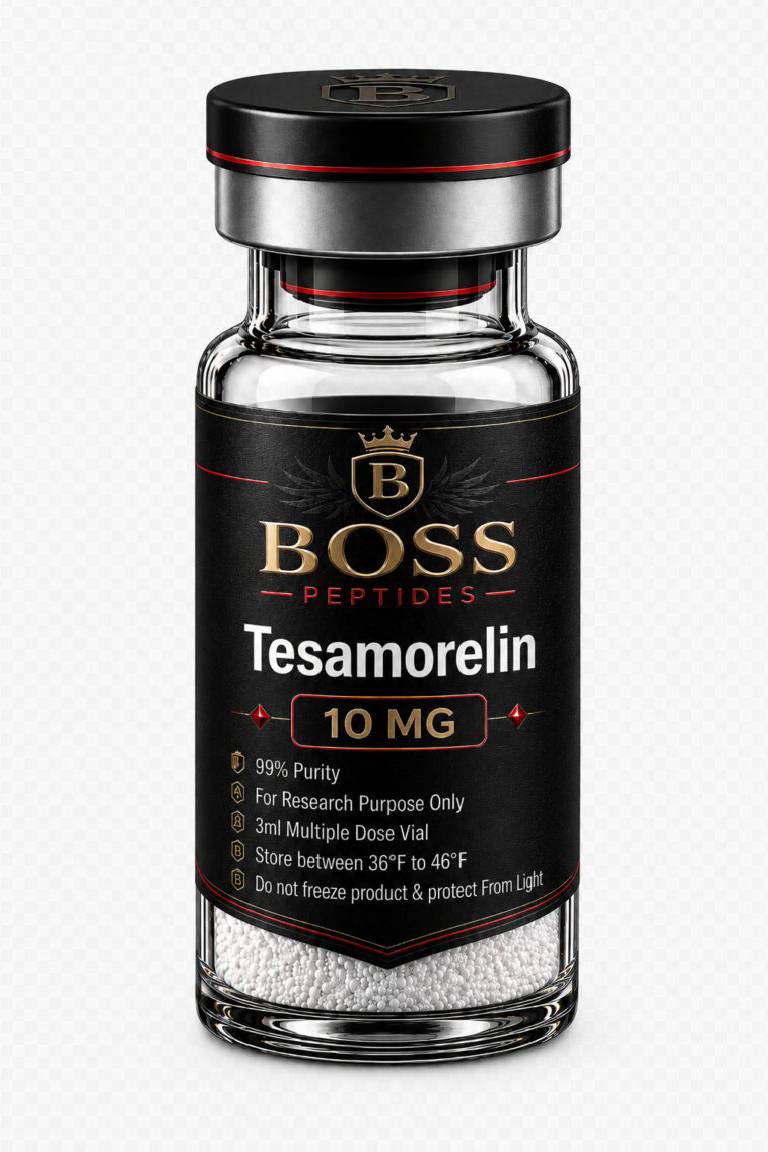
Boss Peptides (bosspeptide.com) lists both as lyophilized research reagents in the GH-Axis Research category: Tesamorelin 10 mg and Sermorelin 10 mg. Those listings are for laboratory research use only. They are not licensed medicines. Related overviews already on the site include the tesamorelin overview and the sermorelin research overview.
Why this comparison comes up in research
Laboratories that work with GHRH-receptor assays often need to know how two catalogue analogues differ in chain length, terminal modification, and the kind of published record attached to each name. Sermorelin is the shorter, unmodified 1–29 fragment, with a historical pharmaceutical program as a former diagnostic agent. Tesamorelin keeps the 44-residue backbone and adds an N-terminal acyl group; a finished pharmaceutical product containing tesamorelin was later studied in a defined clinical-development program and approved for a specific indication. Those two histories are not interchangeable, and a research reagent is not either finished product.
No published randomized study that we identified compares tesamorelin with sermorelin head to head. Claims that one is “stronger” or “better” have no direct trial behind them. The comparison below sets structure and selected papers side by side and names the setting each finding came from.
Comparison at a glance
Values below are for the free peptides as recorded in monographs and public registries, not for a salt form or a specific lot. Confirm sequence, modification, and observed mass on the lot documents.
| Item | Tesamorelin | Sermorelin |
|---|---|---|
| What it is | Synthetic 44-residue GHRH analogue with an N-terminal trans-3-hexenoyl group | Amidated N-terminal 29 residues of human GHRH (GHRH(1-29)-NH2) |
| Sequence / structure notes | trans-3-hexenoyl-Tyr1-GHRH(1-44)-NH2 | GHRH(1-29) amide |
| Residues | 44, plus the N-terminal trans-3-hexenoyl modification; C-terminal amide | 29; C-terminal amide |
| Molecular formula (free peptide) | C221H366N72O67S | C149H246N44O42S |
| Average molecular weight | About 5,136 g/mol (USAN / PubChem CID 16137828) | About 3,358 g/mol (KEGG D08509) |
| CAS Registry Number | 218949-48-5 | 86168-78-7 |
| Reported receptor | GHRH receptor | GHRH receptor |
| Distinct design feature | N-terminal trans-3-hexenoyl group, reported to increase resistance to DPP-IV | Shortest N-terminal fragment reported to retain GHRH-receptor activity in the early analogue literature |
| Main published record | Non-clinical pharmacology; later clinical-development program of a finished pharmaceutical product in a defined population | Historical pharmaceutical program as a former diagnostic agent; smaller adult hormone-measurement papers |
| Listed on this site | Yes — research reagent only | Yes — research reagent only |
Structure and mechanism, as described in the literature
Sermorelin corresponds to GHRH(1-29)-NH2. Native human GHRH is 44 amino acids long; the N-terminal 29 residues were sufficient for receptor activity in the early GHRH-analogue literature, and sermorelin is that amidated fragment (Prakash and Goa, 1999). The KEGG DRUG entry lists the formula C149H246N44O42S and a molecular weight of about 3,358 g/mol, with CAS 86168-78-7 (KEGG D08509). In experimental systems, it is described as a GHRH-receptor agonist that acts on pituitary somatotrophs, with downstream measurements of GH and, in some papers, IGF-I. The circulating half-life of this short fragment is described as short relative to later analogues that were modified for enzymatic stability or albumin binding.
Tesamorelin keeps the 44-residue GHRH backbone and adds a trans-3-hexenoyl group on the N-terminal tyrosine. The U.S. Adopted Name monograph and PubChem record the formula C221H366N72O67S, an average molecular weight of about 5,136 g/mol, and CAS 218949-48-5 (CID 16137828; KEGG D06655). Ferdinandi and colleagues (2007) described non-clinical pharmacology of tesamorelin, including resistance to DPP-IV in experimental systems. That modification, and the extra 15 residues relative to sermorelin, explain most of the practical differences a chemist or an analyst will see: molecular weight, mass spectrum, and stability against a specific peptidase in the assays used in those papers. Both analogues are still described as acting at the GHRH receptor. A potency figure from rat pituitary cells in culture is not a measure of activity in any other system.
What the published clinical-research record looked at — and what it does not transfer
The two compounds were studied clinically in very different settings, which is one reason a direct comparison is hard. In both cases, the papers describe pharmaceutical preparations, not the lyophilized research reagents listed on this site.
Sermorelin. Prakash and Goa (1999) reviewed its use as a provocative test of pituitary GH secretion and in prepubertal children with idiopathic growth hormone deficiency. The same review noted an important limit: a normal response to sermorelin cannot rule out deficiency caused by a hypothalamic problem, so other tests were still needed. Thorner and colleagues (1996) reported a multicenter, open-label study of a finished product in previously untreated children with growth hormone deficiency. In adults, the work is much smaller. Corpas and colleagues (1992) reported GH and IGF-I measurements in a short study of healthy older men. Those papers belong to the history of a finished product that was later discontinued. They are not a protocol for a catalog vial, and they do not establish a general-use result.
Tesamorelin. Under the code TH9507, a finished pharmaceutical product went through randomized, placebo-controlled trials in people with HIV and excess abdominal fat. Falutz and colleagues (2007) reported a 412-participant trial, and later papers reported additional multicenter work in the same clinical-development program (Falutz et al., 2010). The primary endpoint in that program was the change in visceral adipose tissue measured by computed tomography. A 2011 review summarized the trial program of the pharmaceutical product (Dhillon, 2011). That program led to an FDA-approved finished medicine under a brand name, for a defined indication in a defined population. A research reagent that shares a nonproprietary name with that medicine is not the approved product.
The two records should not be swapped. In particular, some later papers refer to “growth hormone-releasing hormone” in the title or abstract while studying tesamorelin specifically. Those results are product-specific. They are not automatically sermorelin evidence, and they are not evidence for a catalog vial of either analogue.
What this comparison is not
This page does not:
- rank the two peptides by “result,” “strength,” or any other outcome
- specify an amount, a schedule, or a route of use
- tell a laboratory or a reader which compound to select for use in people or animals
- transfer findings from one analogue, or from one study population, to the other
- present a research reagent as a finished or former medicine, or a finished medicine as a catalog item
DPP-IV resistance for tesamorelin was shown in experimental systems (Ferdinandi et al., 2007). That finding does not by itself predict what happens in a particular laboratory model. Potency figures for the 1–29 fragment come from the early analogue literature; they are not a ranking of catalog items.
Laboratory handling and storage
If you are holding tesamorelin or sermorelin as a laboratory reagent, storage and handling should follow the lot documents and standard practice for lyophilized peptides. A separate guide, How to Store Peptides in the Lab, covers arrival checks, temperature, moisture, light, aliquots, and what changes once a protocol requires the material in solution. For tesamorelin, confirm that the lot documents specify the N-terminal trans-3-hexenoyl modification and the 44-residue chain, not a 29-residue GHRH fragment.
Related research materials listed on this site
Boss Peptides lists the following lyophilized research reagents in GH-Axis Research:
Related listings include CJC-1295 DAC 5 mg and 10 mg, and Ipamorelin 10 mg. See also the tesamorelin overview, the sermorelin research overview, and a companion article comparing ipamorelin, sermorelin, and CJC-1295 DAC. All listings are for laboratory research use only.
Frequently asked questions
What is the main chemical difference between tesamorelin and sermorelin?
Both are GHRH-receptor analogues. Sermorelin is the amidated 29-residue N-terminal fragment. Tesamorelin is a 44-residue analogue with an N-terminal trans-3-hexenoyl group (Prakash and Goa, 1999; Ferdinandi et al., 2007). They differ in length, molecular weight, and that terminal modification.
Has a trial compared the two head to head?
No published randomized study that we identified compares tesamorelin with sermorelin directly. Their clinical papers studied different products in different populations for different questions.
Is a tesamorelin research reagent the same as the approved medicine?
No. A finished pharmaceutical product containing tesamorelin was approved for a defined indication. The vial listed on this site is a lyophilized research reagent, not that medicine.
Was sermorelin an approved medicine?
A finished sermorelin product was previously marketed as a diagnostic agent under a brand name and was later discontinued. A research reagent is not that product, and this page is not a diagnostic protocol.
Does this page recommend one compound over the other?
No. It compares structure and selected papers. It does not rank outcomes and it does not provide a use protocol.
Research-use limitation
All Boss Peptides catalog items are sold for laboratory research use only. They are not for human or animal consumption, not for diagnostic use, and not for administration to people or animals. They are not drugs, foods, dietary supplements, or cosmetics, and they are not intended to diagnose, treat, cure, or prevent any disease. See the RUO statement, the disclaimer, and About Boss Peptides.
Sources
PubMed and registry links below were checked on 23 November 2026. Where a publisher page blocks automated retrieval, the PubMed record is the link used here.
Corpas, E., Harman, S. M., Piñeyro, M. A., Roberson, R., & Blackman, M. R. (1992). Growth hormone (GH)-releasing hormone-(1-29) twice daily reverses the decreased GH and insulin-like growth factor-I levels in old men. Journal of Clinical Endocrinology and Metabolism, 75(2), 530–537. https://pubmed.ncbi.nlm.nih.gov/1379256/
Dhillon, S. (2011). Tesamorelin: A review of its use in the management of HIV-associated lipodystrophy. Drugs, 71(8), 1071–1091. https://pubmed.ncbi.nlm.nih.gov/21696164/
Falutz, J., Allas, S., Blot, K., Potvin, D., Kotler, D., Somero, M., Berger, D., Brown, S., Richmond, G., Fessel, J., Turner, R., & Grinspoon, S. (2007). Metabolic effects of a growth hormone–releasing factor in patients with HIV. New England Journal of Medicine, 357(19), 1929–1938. https://pubmed.ncbi.nlm.nih.gov/18057338/
Falutz, J., Potvin, D., Mamputu, J. C., Assaad, H., Zoltowska, M., Michaud, S. E., Berger, D., Somero, M., Moyle, G., Brown, S., Martorell, C., Turner, R., & Grinspoon, S. (2010). Effects of tesamorelin, a growth hormone-releasing factor, in HIV-infected patients with abdominal fat accumulation: A randomized placebo-controlled trial with a safety extension. Journal of Acquired Immune Deficiency Syndromes, 53(3), 311–322. https://pubmed.ncbi.nlm.nih.gov/20101189/
Ferdinandi, E. S., Brazeau, P., High, K., Procter, B., Fennell, S., & Schiavi, P. (2007). Non-clinical pharmacology and safety evaluation of tesamorelin, a human growth hormone-releasing factor analogue. Basic and Clinical Pharmacology and Toxicology, 100(1), 49–58. https://pubmed.ncbi.nlm.nih.gov/17214613/
KEGG DRUG D06655, tesamorelin. https://www.kegg.jp/entry/D06655
KEGG DRUG D08509, sermorelin. https://www.kegg.jp/entry/D08509
Prakash, A., & Goa, K. L. (1999). Sermorelin: A review of its use in the diagnosis and treatment of children with idiopathic growth hormone deficiency. BioDrugs, 12(2), 139–157. https://pubmed.ncbi.nlm.nih.gov/18031173/
PubChem CID 16137828 (tesamorelin). https://pubchem.ncbi.nlm.nih.gov/compound/16137828
Thorner, M., Rochiccioli, P., Colle, M., Lanes, R., Grunt, J., Galazka, A., Landy, H., Eengrand, P., & Shah, S., for the Geref International Study Group. (1996). Once daily subcutaneous growth hormone-releasing hormone therapy accelerates growth in growth hormone-deficient children during the first year of therapy. Journal of Clinical Endocrinology and Metabolism, 81(3), 1189–1196. https://pubmed.ncbi.nlm.nih.gov/8772599/