
Sub-Total: $0.00
Retatrutide Vial Sizes Explained (15–60 mg) for Lab Inventory
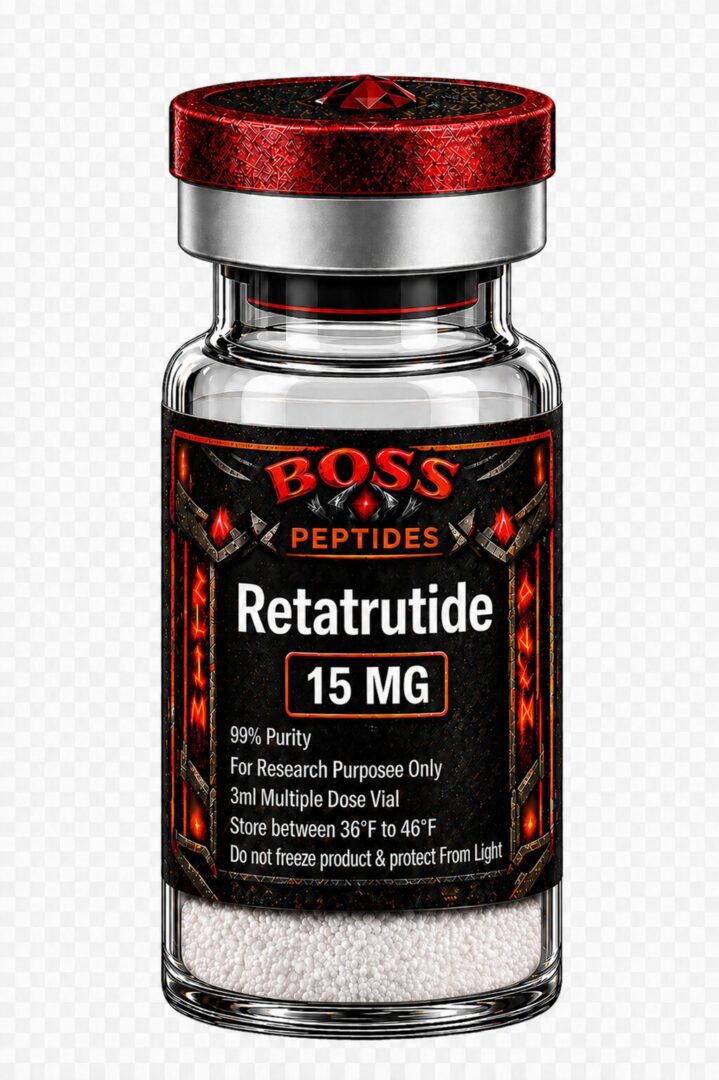
Boss Peptides (bosspeptide.com) lists retatrutide as a lyophilized research reagent in five labeled sizes: 15 mg, 20 mg, 30 mg, 40 mg, and 60 mg. The compound on each page is the same research material. The pages differ in how much mass is in the sealed vial, in the SKU, and in the lot paperwork that belongs to that strength. This article explains those listings as a laboratory-inventory choice. It is not a protocol, and it does not recommend a size for any experiment.
A longer account of the compound’s identity and the published receptor-pharmacology background is on Retatrutide: A Research Overview. The five product pages, and the Metabolic Receptor Research category, are the catalog sources for current availability.
What this catalog lists, and what it does not
In the published literature, retatrutide is described as a single-chain peptide agonist at three class B G-protein-coupled receptors: the GIP receptor, the GLP-1 receptor, and the glucagon receptor. Discovery papers also use the research code LY3437943. That identity is the same across the five sizes in this catalog.
Each listing is a research material, not a drug. A related drug candidate has been discussed in published trials; those papers describe that candidate and the models in which it was studied. They are not results for a commercial vial, and they are not a reason to pick one catalog size over another.
This article does not compare receptor activity by vial size. A 60 mg vial is not a “stronger” reagent than a 15 mg vial. It is more mass of the same listed compound in one container. Assay design, concentrations, and methods belong in the primary literature and in a laboratory’s own protocols — not in a catalog size chart.
The five lyophilized sizes
The current catalog pages, with the names used on the live site, are:
- Retatrutide 15MG — the smallest listing; SKU BOSS-RETA-15-001
- Retatrutide 20MG — one step above 15 mg; SKU BOSS-RETA-20-001
- Retatrutide 30MG — the midpoint of the range; SKU BOSS-RETA-30-001
- Retatrutide 40MG — the upper-mid listing; SKU BOSS-RETA-40-001
- Retatrutide 60MG — the largest listing; SKU BOSS-RETA-60-001
All five are sealed laboratory vials of lyophilized material, labeled with the compound name and strength. Unit prices and volume-pricing tiers are set per listing and do not combine different sizes of the same compound. A laboratory that wants more than one size should add each listing separately and record each SKU in inventory.
In inventory terms, the smaller listings (15 mg and 20 mg) fit method setup, a short assay series, or a spare sealed container. The 30 mg and 40 mg listings give one inventory line for a defined or longer block of work, with fewer open-vial events than several small vials. The 60 mg listing is the high-mass shared-stock or extended-series vial, which can lower reorder frequency and the number of lots in circulation. Those are inventory descriptions only, not a substitute for a laboratory’s own consumption records.
Inventory reasons laboratories split a compound by size
Laboratories split a single compound into several vial sizes for practical reasons that have nothing to do with changing the molecule.
Opened-container control. Once a lyophilized vial is in active use, many labs prefer not to leave a large remaining mass tied to that opened container if the next work block is small. A smaller vial can sit on the bench while a larger sealed vial stays in storage.
Lot grouping. A longer project that draws from one 60 mg vial may involve a single lot record. The same mass drawn from several 15 mg vials may involve one lot or several, depending on what was shipped. Neither pattern is automatically better; the point is to know which pattern is in use and to document it.
Shared versus single-bench stock. A shared refrigerator or freezer often favors a larger vial and a single inventory entry. A single bench running a short method may favor a smaller vial that is easier to assign to one project.
Reorder planning. Larger vials can reduce how often a compound is reordered. Smaller vials can reduce how much mass is committed when a project is still being scoped. Catalog volume-pricing tiers, where they apply, are also set per listing, so the size choice and the order quantity should be planned together.
Separation of workstreams. Some groups keep a small vial for method development and a larger vial for a later series of the same assays, so early work does not draw down reserved stock.
Lots, paperwork, and why strength matters
Third-party lot reports, when posted, are collected on the Lab Reports page. That page states that each report applies only to the lot number and the strength that were tested, and that a report for one strength is not a report for a different strength of the same compound.
At the time of writing, a third-party report for a 15 mg retatrutide lot was posted there. That report does not cover a 20 mg, 30 mg, 40 mg, or 60 mg vial, and it does not cover a different 15 mg lot. Anyone using a 15 mg vial should match the lot number on the vial to the report before relying on it.
For sizes that do not yet have a posted report at the matching strength, lot documents are available on request at info@bosspeptide.com. If a matching report is posted later, it will appear on the Lab Reports page. Product pages that do not display a public PDF are not claiming that no paperwork exists; they are directing the laboratory to request the documents for the lot actually received.
Inventory practice is straightforward: record the SKU, the labeled strength, and the lot number when the vial arrives, and keep that record with the project that consumes the vial. Do not file a 15 mg report against a 40 mg or 60 mg container.
Storage and handling as inventory practice
Follow the lot documents and the vial label first. For general laboratory practice with sealed lyophilized materials in this catalog, see How to Store Peptides in the Lab. Common inventory habits include keeping unused vials sealed, protected from light, and in the storage condition specified for that lot; letting a cold, sealed vial equilibrate before opening; and avoiding repeated freeze–thaw of any solutions a laboratory prepares under its own procedures.
Size choice interacts with those habits. A larger vial that will be opened many times over a long calendar requires a clearer plan for how the remaining material will be stored between sessions. A smaller vial may be consumed in a shorter window. Institutional laboratory procedures, not this article, govern how a given bench handles an opened vial.
Related receptor-research reading
For compound identity and published receptor context, start with Retatrutide: A Research Overview. For a comparison of receptor targets with related incretin-pathway agonists discussed in the literature, see Retatrutide, Tirzepatide, and Semaglutide: Receptor Targets Compared. Current stock and pricing for each size remain on the five product pages listed above and in the Metabolic Receptor Research category.
Primary papers remain the right source for methods and limitations. This article is an inventory guide to the catalog sizes, not a review of experimental outcomes.
Research-use-only disclaimer
This article is a laboratory reference from Boss Peptides (bosspeptide.com). Every compound named here is a research reagent for laboratory research use only. It is not a medicine, food, dietary supplement, or cosmetic, and this article is not advice for use in people, animals, or clinical practice. It does not give preparation, handling, or experimental-protocol instructions. Readers should consult primary papers, lot documents, and their institution’s procedures before any laboratory work.