
Sub-Total: $0.00
Humanin S14G Research Overview
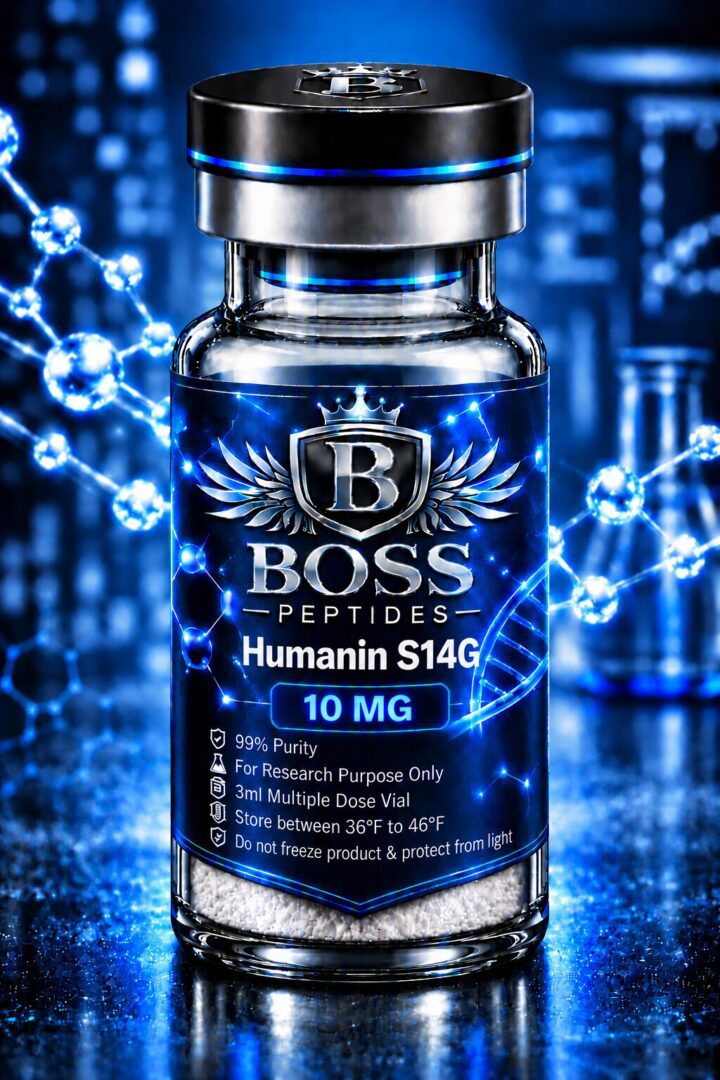
This page is the research hub for Humanin S14G at Boss Peptides (bosspeptide.com). The catalog item is the S14G analog (HNG), not wild-type humanin. The material is sold for laboratory research use only.
Specifications
Wild-type humanin is a 24-residue peptide (sequence MAPRGFSCLLLLTSEIDLPVKRRA; CAS 330936-69-1). Humanin S14G, also called HNG or [Gly14]-humanin, is the same chain except that residue 14 is glycine rather than serine (MAPRGFSCLLLLTGEIDLPVKRRA; CAS 330936-70-4). Those two CAS numbers are consecutive and both resolve in PubChem to distinct CIDs. Values below are for the free S14G peptide as computed in PubChem, not for a salt form or a specific lot.
| Compound sold here | Humanin S14G (also called HNG, S14G-humanin, [Gly14]-humanin). This is not wild-type humanin. |
|---|---|
| Difference from wild-type humanin | Serine at position 14 is replaced by glycine. Wild-type humanin is a different molecule (CAS 330936-69-1, PubChem CID 16131438, formula C119H204N34O32S2, average MW 2687.2 g/mol, sequence MAPRGFSCLLLLTSEIDLPVKRRA). |
| CAS Registry Number (S14G) | 330936-70-4 (PubChem CID 16135997) |
| Sequence (S14G) | MAPRGFSCLLLLTGEIDLPVKRRA (H-Met-Ala-Pro-Arg-Gly-Phe-Ser-Cys-Leu-Leu-Leu-Leu-Thr-Gly-Glu-Ile-Asp-Leu-Pro-Val-Lys-Arg-Arg-Ala-OH) |
| Residues | 24; free N-terminus; free C-terminal acid |
| Molecular formula | C118H202N34O31S2 (free peptide) |
| Average molecular weight | 2657.2 g/mol (PubChem, computed) |
| Exact / monoisotopic mass | 2656.4750230 Da / 2655.4716681 Da (PubChem, computed) |
| InChIKey | WUYRHUFIUFJVQU-XJUNAYMOSA-N |
| Form sold here | Lyophilized powder in a sealed laboratory vial |
| Sizes in this catalog | 10 mg only |
| Storage | This sequence contains cysteine and methionine, which laboratory references flag as more prone to oxidation. Follow the lot documents; protect from light and limit how often the vial is opened. See storage notes below. |
Sizes in the Boss Peptides catalog
- Humanin S14G 10MG — SKU BOSS-HUMANIN-S14G-001
This site does not currently list a wild-type humanin vial. Do not treat this product page as a wild-type humanin listing.
Storage notes
Follow the storage line on the lot documents and the vial label first. The shop’s storage guide for lyophilized research materials recommends keeping the dry cake tightly closed, dry, and protected from light; about −20 °C for routine or medium-term storage of the dry cake; and about −80 °C when a lot is held for the long term. Refrigerator temperature (about 4 °C) is described there as a short holding condition only, and only when the lot documents allow it. Let a cold, sealed vial reach room temperature in a dry environment before opening it, to limit condensation on the cake. Avoid repeated freeze–thaw cycles once a solution is prepared. See How to Store Peptides in the Lab. For related mitochondrial-derived research context, see the MOTS-c research overview; MOTS-c is listed in the Cellular Signaling Research group.
Because this sequence includes cysteine and methionine, the storage guide’s notes on oxidation-prone residues apply: keep the vial tightly closed, protected from light, and opened only as needed. Follow the lot documents if they are more specific.
Literature summary
Hashimoto and colleagues described humanin in 2001 in cell-model papers (PMID 11327724, PMID 11717357). Later work examined the S14G analog (HNG) as a distinct synthetic sequence, including a structural study (PMID 17627606). Paper titles in this literature often use disease-model language. Those titles are not claims about this product, and the findings are not results for this vial. They are not instructions for any use outside the laboratory.
Research-use limitation
For laboratory research use only. Not for human or animal consumption. This material is not a drug, food, dietary supplement, or cosmetic, and it is not intended to diagnose, treat, cure, or prevent any disease. Boss Peptides (bosspeptide.com) does not provide human or veterinary use guidance. Information on this page summarizes published literature and reference identifiers for scientific and educational use. It is not a claim about the effects of this product.
Sources
- PubChem CID 16135997 — CAS 330936-70-4, formula C118H202N34O31S2, average MW 2657.2 g/mol, title H-Met-Ala-Pro-Arg-Gly-Phe-Ser-Cys-Leu-Leu-Leu-Leu-Thr-Gly-Glu-Ile-Asp-Leu-Pro-Val-Lys-Arg-Arg-Ala-OH, synonym “(Gly14)-Humanin (human) trifluoroacetate salt”. Retrieved November 20, 2026. The trifluoroacetate wording is a PubChem synonym; the lot COA should state the salt form actually supplied.
- PubChem CID 16131438, humanin — wild-type record, CAS 330936-69-1, used only for comparison.
- Hashimoto et al., Biochem. Biophys. Res. Commun. 2001; PMID 11327724 — early paper describing humanin as a peptide studied in cell models related to amyloid-precursor-protein research.
- Hashimoto et al., J. Neurosci. 2001; PMID 11717357 — further characterization of humanin in published cell-model work.
- Rojo-Domínguez et al., Protein Pept. Lett. 2007; PMID 17627606 — structural preferences of the S14G-humanin analog (HNG).
- Boss Peptides, How to Store Peptides in the Lab — notes on sequences that contain cysteine or methionine.