
Sub-Total: $0.00
Tirzepatide: A Research Overview
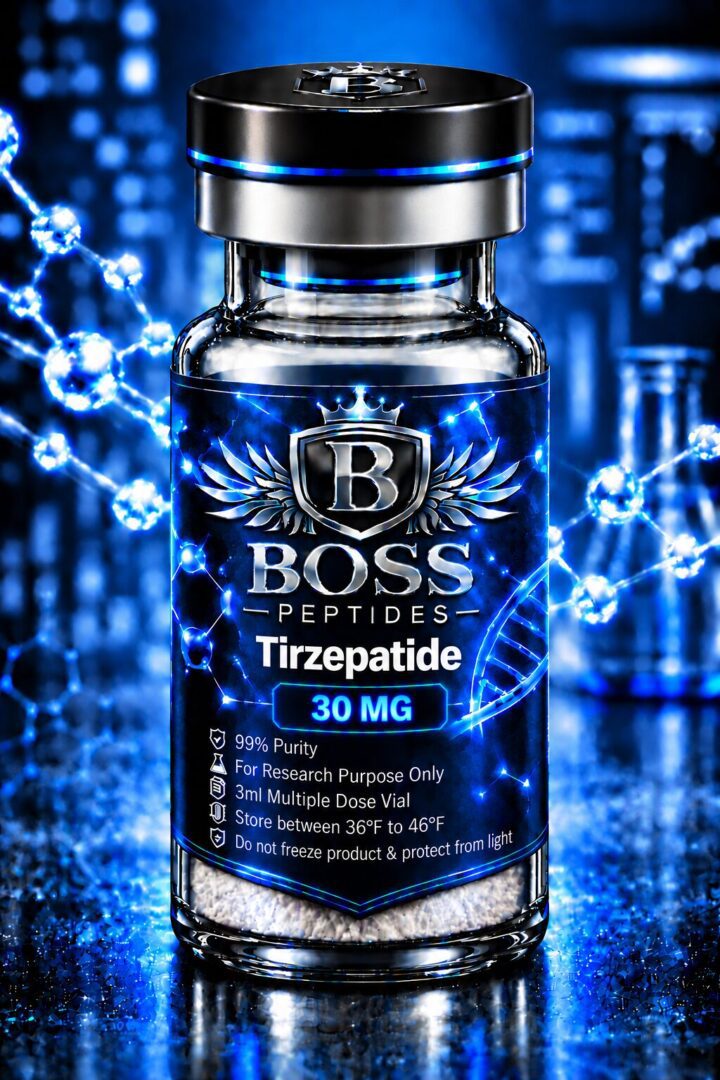
For laboratory research use only. Not for human or animal consumption. This is a research overview of tirzepatide as a laboratory compound. It is not medical advice or a use protocol, and it is not a claim that a research reagent sold on this site is safe, effective, or approved for people or for animals used as patients.
Tirzepatide is a synthetic, lipidated peptide developed under the code LY3298176. In the published literature it is described as a single-chain dual agonist at the glucose-dependent insulinotropic polypeptide receptor (GIPR) and the glucagon-like peptide-1 receptor (GLP-1R) (Coskun et al., 2018). Finished drug products that contain tirzepatide have since been approved in the United States under separate brand names. That fact matters for how this page is read: an approved finished medicine and a lyophilized research reagent that shares a nonproprietary name are not the same product, are not labeled for the same use, and are not interchangeable.
This overview is for laboratory readers who want a careful account of the compound’s identity and the published receptor pharmacology. Boss Peptides (bosspeptide.com) lists tirzepatide as a research reagent in the Metabolic Receptor Research category. Those listings are for laboratory research use only.
What the compound is, and what it is not
Tirzepatide is a 39-amino-acid peptide with a C-terminal amide. The discovery paper describes a linear chain conjugated, at the lysine in position 20, to a C20 fatty diacid through a linker, and it notes two non-coded residues of α-aminoisobutyric acid (Aib) at positions 2 and 13 (Coskun et al., 2018). As with other lipidated incretin-receptor agonists, the fatty-diacid modification is discussed in that paper in connection with albumin binding and an extended circulating half-life.
The USAN Council monograph and the KEGG DRUG entry list the molecular formula as C225H348N48O68 and a molecular weight of about 4,813 g/mol, with CAS Registry Number 2023788-19-2 (KEGG DRUG D11360). The 2018 discovery paper reported a mass of 4,810.52 Da for the peptide as characterized in that work (Coskun et al., 2018). Small differences between a monoisotopic or experimentally measured mass and an average molecular weight from a monograph are expected; the certificate of analysis for a given lot is the document that states what was measured on that lot.
Two points follow from the regulatory record and should not be blurred:
Tirzepatide is the active ingredient in approved finished drug products sold under separate brand names. A research reagent from this catalog is not those products and is not interchangeable with them. It is for laboratory research use only.
Identifiers and structure
| Item | Value | Source |
|---|---|---|
| Nonproprietary name | tirzepatide | USAN; KEGG D11360 |
| Development code | LY3298176 | Coskun et al., 2018 |
| CAS Registry Number | 2023788-19-2 | KEGG D11360 |
| Molecular formula | C225H348N48O68 | KEGG D11360 |
| Approximate molecular weight | 4,813 g/mol | KEGG D11360 |
| Chain length | 39 amino acids, C-terminal amide | Coskun et al., 2018; KEGG D11360 |
Receptor targets in published studies
Coskun and colleagues (2018) introduced LY3298176 as a dual agonist engineered from a GIP-receptor-active peptide backbone, with activity also at GLP-1R. The paper reports in vitro receptor binding and signaling and experiments in animal models. In cell systems, the authors described activity at both GIPR and GLP-1R. They did not describe glucagon-receptor agonism as part of this molecule’s design; that third target is the main pharmacological distinction drawn later for retatrutide (Coskun et al., 2022). See the retatrutide research overview for that comparison.
A dual-agonist description is a statement about receptor pharmacology. It is not a prediction of the result of any particular laboratory assay, and it is not a claim about a vial on this site. Laboratories should read the primary methods when they design experiments around GIPR, GLP-1R, or both.
Scope of the published literature
Beyond the receptor pharmacology above, the published record for tirzepatide includes papers from a pharmaceutical development program and, later, from approved finished drug products. Those papers are listed in the sources for readers who want the primary literature. They describe those products, not a lyophilized research reagent, and this page does not restate their findings as claims about any product on this site.
How it differs from retatrutide and semaglutide
In the literature, these three peptides are often grouped by receptor target:
- Semaglutide — GLP-1 receptor agonist
- Tirzepatide — dual agonist at GIPR and GLP-1R (Coskun et al., 2018)
- Retatrutide — agonist at GIPR, GLP-1R, and the glucagon receptor (Coskun et al., 2022)
That is a comparison of reported receptor activity, not a recommendation and not a ranking. Boss Peptides does not sell semaglutide. Retatrutide, as of November 2026, is still described in the literature as investigational; see the retatrutide research overview.
Laboratory handling and storage
If you are holding tirzepatide as a laboratory reagent, storage and handling should follow the lot documents and standard practice for lyophilized, lipidated peptides. The fatty-diacid side chain can affect how the material behaves on surfaces and in solution; the lot’s certificate of analysis and your laboratory’s SOP take precedence over a general article.
A separate guide, How to Store Peptides in the Lab, covers arrival checks, temperature, moisture, light, aliquots, and what changes once a protocol requires the material in solution. In brief, keep the dry cake tightly closed and protected from moisture and light; allow a freezer-cold vial to equilibrate before opening it; and prefer aliquots over repeated freeze–thaw of a working solution.
When a laboratory protocol requires the peptide in solution, the solvent, concentration, and holding conditions are part of that protocol and of the lot documents — not a general recipe for a vendor page to specify. Bacteriostatic water is listed with the laboratory supplies, in 10 mL and 30 mL sizes, for laboratories whose own methods call for it.
What to look for on a certificate of analysis
A useful COA for a research peptide typically identifies the compound, the supplier lot number, the test date, and the laboratory that performed the tests, and it includes analytical traces or values for identity and related substances (for example, HPLC and mass spectrometry). Read the document that belongs to the vial you have. This page does not assign an analytical specification to any lot, and a monograph formula is not a substitute for lot testing.
Research sizes listed on this site
Boss Peptides currently lists tirzepatide as a lyophilized research reagent in the following sizes:
See also the Metabolic Receptor Research category and the retatrutide research overview. All of these listings are for laboratory research use only.
Frequently asked questions
What is tirzepatide? A synthetic 39-amino-acid, lipidated peptide (development code LY3298176) reported as a dual agonist at GIP and GLP-1 receptors (Coskun et al., 2018).
Is tirzepatide approved as a medicine? Finished drug products that contain tirzepatide have been approved in the United States under separate brand names. The vials listed on this site are not those products and are not labeled as medicines.
Are the vials on this site the same as Mounjaro or Zepbound? No. Those names refer to approved finished drug products. A research reagent that shares a nonproprietary name is still a laboratory material, sold for research use only.
How should a laboratory store it? Follow the storage line on the lot’s certificate of analysis and your laboratory’s SOP. The storage guide summarizes common practice for lyophilized peptides.
Does this page give use instructions? No. It does not provide a use protocol, and the products are for laboratory research use only.
Research-use limitation
All Boss Peptides catalog items, including tirzepatide, are sold for laboratory research use only. They are not for human or animal consumption, not for diagnostic use, and not for administration to people or animals. They are not approved finished drug products. See the RUO statement, the disclaimer, and About Boss Peptides.
Specifications
Tirzepatide (LY3298176) is a synthetic 39-residue peptide described in the discovery literature as a dual agonist of the GIP and GLP-1 receptors (PMID 30473097). The published structure includes two Aib residues, a C-terminal amide, and a C20 fatty-diacid moiety on lysine 20. Values below are for the free form as computed in PubChem, not for a salt form or a specific lot.
| Compound | Tirzepatide (development code LY3298176) |
|---|---|
| CAS Registry Number | 2023788-19-2 (listed on PubChem records for tirzepatide, including CID 166567236 and CID 156588324; also DrugBank and ECHA on PubChem’s CAS field) |
| Sequence (backbone, published) | 39 residues, C-terminal amide, two 2-aminoisobutyric acid (Aib) residues, and a C20 fatty-diacid side chain on Lys20 through a γGlu–2×OEG linker. Published one-letter backbone: Y-Aib-EGTFTSDYSI-Aib-LDKIAQ-K*-AFVQWLIAGGPSSGAPPPS-NH2, where K* carries the side chain. Source: Coskun et al., Mol. Metab. 2018 (PMID 30473097). |
| Molecular formula | C225H348N48O68 (includes the lipid side chain; PubChem, free form) |
| Average molecular weight | 4813 g/mol (PubChem, computed) |
| Exact / monoisotopic mass | 4812.5315671 Da / 4810.5248574 Da (PubChem, computed) |
| InChIKey (CID 166567236) | BTSOGEDATSQOAF-MCNPHUAVSA-N |
| Form sold here | Lyophilized powder in a sealed laboratory vial |
| Sizes in this catalog | 20 mg and 30 mg |
| Important distinction | Approved medicines that contain tirzepatide (including the brand names Mounjaro and Zepbound, which appear as synonyms on PubChem) are not what this catalog sells. The listings here are research-use lyophilized material. |
| Storage | See storage notes below. Follow the lot documents first. |
Sizes in the Boss Peptides catalog
- Tirzepatide 20MG — SKU BOSS-Tirzepatide-20-001
- Tirzepatide 30MG — SKU BOSS-Tirzepatide-30-001
Related reading: Retatrutide, Tirzepatide, and Semaglutide: Receptor Targets Compared and Retatrutide: A Research Overview. This site does not sell semaglutide.
Storage notes
Follow the storage line on the lot documents and the vial label first. The shop’s storage guide for lyophilized research materials recommends keeping the dry cake tightly closed, dry, and protected from light; about −20 °C for routine or medium-term storage of the dry cake; and about −80 °C when a lot is held for the long term. Refrigerator temperature (about 4 °C) is described there as a short holding condition only, and only when the lot documents allow it. Let a cold, sealed vial reach room temperature in a dry environment before opening it, to limit condensation on the cake. Avoid repeated freeze–thaw cycles once a solution is prepared. See How to Store Peptides in the Lab.
Sources
PubMed, PMC, and other links below were checked on 20 November 2026. Where a publisher page blocks automated retrieval, the PubMed record is the link used here.
Coskun, T., Sloop, K. W., Loghin, C., Alsina-Fernandez, J., Urva, S., Bokvist, K. B., Cui, X., Briere, D. A., Cabrera, O., Roell, W. C., Kuchibhotla, U., Moyers, J. S., Benson, C. T., Gimeno, R. E., D’Alessio, D. A., & Haupt, A. (2018). LY3298176, a novel dual GIP and GLP-1 receptor agonist for the treatment of type 2 diabetes mellitus: From discovery to clinical proof of concept. Molecular Metabolism, 18, 3–14. https://pubmed.ncbi.nlm.nih.gov/30473097/ (PMC6308032)
Coskun, T., Urva, S., Roell, W. C., Qu, H., Loghin, C., Moyers, J. S., O’Farrell, L. S., Briere, D. A., Sloop, K. W., Thomas, M. K., Pirro, V., Wainscott, D. B., Willard, F. S., Abernathy, M., Morford, L., Du, Y., Benson, C., Gimeno, R. E., Haupt, A., & Milicevic, Z. (2022). LY3437943, a novel triple glucagon, GIP, and GLP-1 receptor agonist for glycemic control and weight loss: From discovery to clinical proof of concept. Cell Metabolism, 34(9), 1234–1247.e9. https://pubmed.ncbi.nlm.nih.gov/35985340/
Frias, J. P., Nauck, M. A., Van, J., Kutner, M. E., Cui, X., Benson, C., Urva, S., Gimeno, R. E., Milicevic, Z., Robins, D., & Haupt, A. (2018). Efficacy and safety of LY3298176, a novel dual GIP and GLP-1 receptor agonist, in patients with type 2 diabetes: A randomised, placebo-controlled and active comparator-controlled phase 2 trial. The Lancet, 392(10160), 2180–2193. https://pubmed.ncbi.nlm.nih.gov/30293770/
Frías, J. P., Davies, M. J., Rosenstock, J., Pérez Manghi, F. C., Fernández Landó, L., Bergman, B. K., Liu, B., Cui, X., & Brown, K. (2021). Tirzepatide versus semaglutide once weekly in patients with type 2 diabetes. New England Journal of Medicine, 385(6), 503–515. https://pubmed.ncbi.nlm.nih.gov/34170647/
Jastreboff, A. M., Aronne, L. J., Ahmad, N. N., Wharton, S., Connery, L., Alves, B., Kiyosue, A., Zhang, S., Liu, B., Bunck, M. C., & Stefanski, A. (2022). Tirzepatide once weekly for the treatment of obesity. New England Journal of Medicine, 387(3), 205–216. https://pubmed.ncbi.nlm.nih.gov/35658024/
KEGG. (n.d.). DRUG: Tirzepatide (D11360). https://www.kegg.jp/entry/D11360
Rosenstock, J., Wysham, C., Frías, J. P., Kaneko, S., Lee, C. J., Fernández Landó, L., Mao, H., Cui, X., Karanikas, C. A., & Thieu, V. T. (2021). Efficacy and safety of a novel dual GIP and GLP-1 receptor agonist tirzepatide in patients with type 2 diabetes (SURPASS-1): A double-blind, randomised, phase 3 trial. The Lancet, 398(10295), 143–155. https://pubmed.ncbi.nlm.nih.gov/34186022/
U.S. National Library of Medicine. (n.d.). A study of tirzepatide (LY3298176) versus semaglutide once weekly as add-on therapy to metformin in participants with type 2 diabetes (NCT03987919). ClinicalTrials.gov. https://clinicaltrials.gov/study/NCT03987919
U.S. National Library of Medicine. (n.d.). A study of tirzepatide (LY3298176) in participants with obesity or overweight (NCT04184622). ClinicalTrials.gov. https://clinicaltrials.gov/study/NCT04184622