
Sub-Total: $0.00
Ipamorelin vs Sermorelin vs CJC-1295 DAC: Receptors Compared
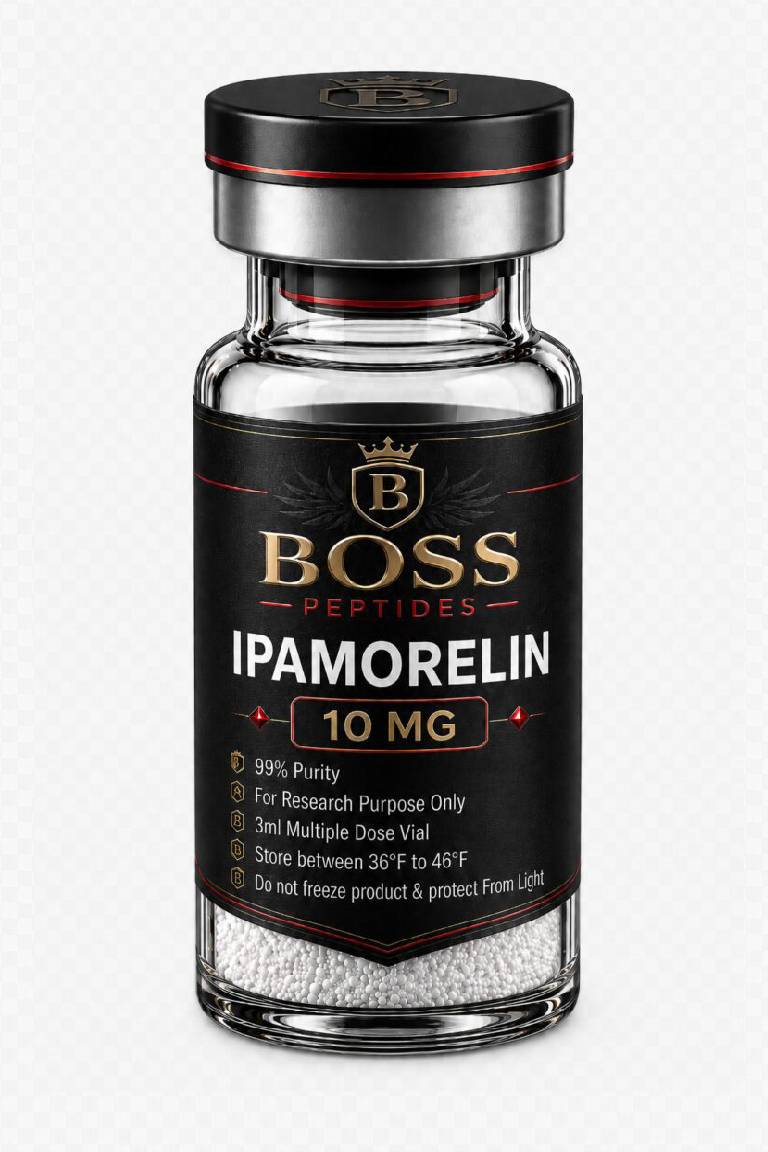
For laboratory research use only. Not for human or animal consumption. This page compares three laboratory peptides that appear together in the growth-hormone (GH) axis literature. It is not medical advice, not a use protocol, and not a ranking of which compound to use. It is not a claim that any research reagent sold on this site is safe, effective, or approved for people or for animals used as patients.
Sermorelin and CJC-1295 with DAC are analogues of growth hormone-releasing hormone (GHRH) and are described as acting at the GHRH receptor. Ipamorelin is a different kind of molecule: a five-residue growth hormone secretagogue described as acting at the ghrelin receptor (also called the GH secretagogue receptor, GHS-R1a), not at the GHRH receptor. The three reagents therefore reach pituitary GH-release pathways through two separate receptors. A published measurement of GH or insulin-like growth factor I (IGF-I) in a paper is not a use instruction for a catalog vial.
Boss Peptides (bosspeptide.com) lists all three as lyophilized research reagents in the GH-Axis Research category: Ipamorelin 10 mg, Sermorelin 10 mg, and CJC-1295 DAC 5 mg and 10 mg. Those listings are for laboratory research use only. They are not licensed medicines. Related overviews already on the site include Sermorelin, Ipamorelin, and GHRH Research and the sermorelin research overview.
Why a receptor comparison is useful in research
A GHRH-receptor agonist and a ghrelin-receptor agonist are different tools for different assay questions. Even within the GHRH-receptor group, sermorelin is the amidated 1–29 fragment of the natural hormone, while CJC-1295 with DAC is a modified analogue designed to bind albumin and remain in circulation longer. The name “CJC-1295” is also used for a version without the albumin-binding group, often written “CJC-1295 without DAC” or “Mod GRF 1-29.” Those two forms are not interchangeable. The catalog items on this site are the DAC form.
No published trial that we identified compares the three compounds head to head. The comparison below sets their chemical identities and selected papers side by side and names the model each finding came from.
Comparison at a glance
Values below are for the free peptides as commonly recorded in monographs or discovery papers, not for a salt form or a specific lot. Confirm sequence, modification, and observed mass on the lot documents.
| Item | Ipamorelin | Sermorelin | CJC-1295 with DAC |
|---|---|---|---|
| What it is | Synthetic pentapeptide | Amidated N-terminal 29 residues of human GHRH (GHRH(1-29)-NH2) | Modified GHRH(1-29) analogue with a C-terminal lysine linked to a maleimidopropionyl group (drug affinity complex) designed to bind albumin |
| Sequence / structure notes | Aib-His-D-2-Nal-D-Phe-Lys-NH2 (Raun et al., 1998) | GHRH(1-29) amide | Tetrasubstituted GHRH(1-29) plus Lys30 with an N-ε-maleimidopropionyl group (Jetté et al., 2005) |
| Residues | 5, including non-coded and D-amino-acid residues; C-terminal amide | 29; C-terminal amide | 30-residue analogue plus the DAC modification; C-terminal amide |
| Molecular formula (free peptide) | C38H49N9O5 | C149H246N44O42S | Commonly reported as C165H269N47O46 for the unconjugated peptide; confirm on the lot documents |
| Average molecular weight | 711.9 g/mol (PubChem CID 9831659) | About 3,358 g/mol (KEGG D08509) | Commonly reported as about 3,647 g/mol for the unconjugated peptide; confirm on the lot documents |
| CAS Registry Number | 170851-70-4 (free peptide) | 86168-78-7 | Lot-specific; do not assume a single CAS covers every salt or every “CJC-1295” form |
| Reported receptor | Ghrelin receptor / GHS-R1a | GHRH receptor | GHRH receptor |
| Representative sources | Raun et al., 1998; Gobburu et al., 1999 | Prakash and Goa, 1999; KEGG D08509 | Jetté et al., 2005; Teichman et al., 2006 |
| Listed on this site | Yes — research reagent only | Yes — research reagent only | Yes — DAC form, 5 mg and 10 mg, research reagent only |
Two receptors, three molecules
Sermorelin is the simplest of the three. Prakash and Goa (1999) reviewed it as a 29-amino-acid analogue of human GHRH and as the shortest synthetic peptide reported to retain the hormone’s receptor activity. Native human GHRH is 44 amino acids long; the N-terminal 29 residues are the fragment used here, with a C-terminal amide. The KEGG DRUG entry lists the formula C149H246N44O42S and a molecular weight of about 3,358 g/mol, with CAS 86168-78-7 (KEGG D08509). Finished products containing sermorelin were previously marketed as diagnostic agents under a brand name (Geref). That program was later discontinued. A research reagent is not those products, and this page is not a diagnostic protocol.
CJC-1295 with DAC starts from the same 29-residue GHRH framework. Jetté and colleagues (2005) described a tetrasubstituted analogue with an added C-terminal lysine conjugated to a maleimidopropionyl group, a design intended to form a covalent conjugate with albumin and thereby remain detectable in circulation longer. In rats, the authors reported that the compound was still detectable in plasma beyond 72 hours (Jetté et al., 2005). The unconjugated peptide is commonly listed with a molecular formula of C165H269N47O46 and an average molecular weight of about 3,647 g/mol; salt form and naming vary, so the lot documents are the source for a given vial. A version without the albumin-binding group is a different reagent.
Ipamorelin is unrelated to GHRH in structure. Raun and colleagues (1998) described it as the pentapeptide Aib-His-D-2-Nal-D-Phe-Lys-NH2, identified in a chemistry program that started from growth hormone-releasing peptide (GHRP) analogues. In primary rat pituitary cells, the authors reported that ipamorelin released GH with a potency and a maximum effect similar to GHRP-6, and that antagonist profiling placed its activity on a GHRP-like receptor rather than on the GHRH receptor (Raun et al., 1998). That receptor is now generally identified as the ghrelin receptor, GHS-R1a. The same paper reported that, in swine, comparison compounds raised ACTH and cortisol, and that ipamorelin did not raise those hormones significantly more than GHRH did. Those are findings in the models and assays used in that paper. PubChem records the free peptide as C38H49N9O5, with an average molecular weight of 711.9 g/mol and CAS 170851-70-4 (CID 9831659).
None of the three is a preparation of GH itself.
What selected papers measured
Sermorelin has the longest pharmaceutical record of the three because a finished product went through an approval and was later discontinued. Thorner and colleagues (1996), writing for the Geref International Study Group, reported a multicenter, open-label study in previously untreated children with growth hormone deficiency. That paper belongs to the history of a finished diagnostic and endocrine product. It does not describe a research reagent, and it is not a protocol for a catalog vial. In adults, the published record is smaller. Corpas and colleagues (1992) reported GH and IGF-I measurements in a short study of healthy older men. That is a hormone-measurement paper, not a general-use result.
CJC-1295 with DAC was studied in healthy adults in randomized, placebo-controlled work reported by Teichman and colleagues (2006). The authors reported increases in mean plasma GH and IGF-I in that study and estimated a circulating half-life of 5.8 to 8.1 days for the investigational product used there. A related paper reported that pulsatile GH secretion persisted during continued exposure to this long-acting analogue (Ionescu and Frohman, 2006). Those papers describe an investigational pharmaceutical preparation. They are not results for a lyophilized catalog item, and they are not a schedule for laboratory or other use.
Ipamorelin has early human pharmacokinetic and pharmacodynamic work. Gobburu and colleagues (1999) modeled the relationship between ipamorelin concentrations and GH in healthy volunteers. Later clinical-development work in other settings, including postoperative gastrointestinal-motility studies, is part of the compound’s development history and has not produced an FDA-approved drug product. Raun and colleagues (1998) remains the primary source for the receptor-class assignment and for the selectivity observations in the animal and cell models used there.
The three records are therefore not parallel. Sermorelin’s deepest published program is historical and product-specific. CJC-1295 with DAC has healthy-adult hormone-measurement studies of an investigational analogue designed to last longer in circulation. Ipamorelin has discovery pharmacology plus early human GH-release modeling, through a different receptor. None of those programs is a head-to-head comparison, and none of them is a result for the research reagents listed on this site.
What this comparison is not
This page does not:
- rank the three peptides by “result,” “strength,” duration, or any other outcome
- specify an amount, a schedule, or a route of use
- tell a laboratory or a reader which compound to select for use in people or animals
- treat CJC-1295 with DAC and CJC-1295 without DAC as the same reagent
- present a research reagent as a finished or former medicine
- describe a combination of a GHRH-receptor agonist and a ghrelin-receptor agonist as a validated “stack”
Some laboratory protocols include more than one GH-axis reagent in the same experiment in order to ask a receptor-interaction question. That is a design choice for a written protocol, with its own controls and end points. This site does not provide combination protocols.
Laboratory handling and storage
If you are holding ipamorelin, sermorelin, or CJC-1295 with DAC as a laboratory reagent, storage and handling should follow the lot documents and standard practice for lyophilized peptides. A separate guide, How to Store Peptides in the Lab, covers arrival checks, temperature, moisture, light, aliquots, and what changes once a protocol requires the material in solution. For CJC-1295, confirm that the lot documents specify the DAC form rather than a no-DAC analogue. For ipamorelin, confirm that the residue sequence matches the discovery paper, including the D-amino acids and the C-terminal amide.
Related research materials listed on this site
Boss Peptides lists the following lyophilized research reagents in GH-Axis Research:
Related listings include Tesamorelin 10 mg and GHRP-2 10 mg. See also Sermorelin, Ipamorelin, and GHRH Research, the sermorelin research overview, and a companion article comparing tesamorelin and sermorelin. All listings are for laboratory research use only.
Frequently asked questions
What is the main difference among these three peptides?
Sermorelin and CJC-1295 with DAC are GHRH-receptor analogues. Ipamorelin is a pentapeptide reported to act at the ghrelin receptor, not at the GHRH receptor (Raun et al., 1998; Prakash and Goa, 1999; Jetté et al., 2005). CJC-1295 with DAC is further distinguished from sermorelin by sequence substitutions and an albumin-binding modification.
Is CJC-1295 with DAC the same as CJC-1295 without DAC?
No. The DAC form is designed to bind albumin. The form without DAC, often called Mod GRF 1-29, lacks that group and is a different reagent. This catalog lists the DAC form.
Was sermorelin an approved medicine?
A finished sermorelin product was previously marketed as a diagnostic agent under a brand name and was later discontinued. A research reagent is not that product, and this page is not a diagnostic protocol. Ipamorelin and CJC-1295 have not been approved by the FDA as drug products.
Does this page recommend one compound over the others?
No. It compares reported receptors, structure, and selected papers. It does not rank outcomes and it does not provide a use protocol.
Are the vials on this site finished medicines?
No. They are lyophilized research reagents. Finished or former drug products, where they existed, are separate products and are not what this catalog sells.
Research-use limitation
All Boss Peptides catalog items are sold for laboratory research use only. They are not for human or animal consumption, not for diagnostic use, and not for administration to people or animals. They are not drugs, foods, dietary supplements, or cosmetics, and they are not intended to diagnose, treat, cure, or prevent any disease. See the RUO statement, the disclaimer, and About Boss Peptides.
Sources
PubMed and registry links below were checked on 23 November 2026. Where a publisher page blocks automated retrieval, the PubMed record is the link used here.
Corpas, E., Harman, S. M., Piñeyro, M. A., Roberson, R., & Blackman, M. R. (1992). Growth hormone (GH)-releasing hormone-(1-29) twice daily reverses the decreased GH and insulin-like growth factor-I levels in old men. Journal of Clinical Endocrinology and Metabolism, 75(2), 530–537. https://pubmed.ncbi.nlm.nih.gov/1379256/
Gobburu, J. V., Agersø, H., Jusko, W. J., & Ynddal, L. (1999). Pharmacokinetic-pharmacodynamic modeling of ipamorelin, a growth hormone releasing peptide, in human volunteers. Pharmaceutical Research, 16(9), 1412–1416. https://pubmed.ncbi.nlm.nih.gov/10496658/
Ionescu, M., & Frohman, L. A. (2006). Pulsatile secretion of growth hormone (GH) persists during continuous stimulation by CJC-1295, a long-acting GH-releasing hormone analog. Journal of Clinical Endocrinology and Metabolism, 91(12), 4792–4797. https://pubmed.ncbi.nlm.nih.gov/17018654/
Jetté, L., Léger, R., Thibaudeau, K., Benquet, C., Robitaille, M., Pellerin, I., Paradis, V., van Wyk, P., Pham, K., & Bridon, D. P. (2005). Human growth hormone-releasing factor (hGRF)1–29-albumin bioconjugates activate the GRF receptor on the anterior pituitary in rats: Identification of CJC-1295 as a long-lasting GRF analog. Endocrinology, 146(7), 3052–3058. https://pubmed.ncbi.nlm.nih.gov/15817669/
KEGG DRUG D08509, sermorelin. https://www.kegg.jp/entry/D08509
Prakash, A., & Goa, K. L. (1999). Sermorelin: A review of its use in the diagnosis and treatment of children with idiopathic growth hormone deficiency. BioDrugs, 12(2), 139–157. https://pubmed.ncbi.nlm.nih.gov/18031173/
PubChem CID 9831659 (ipamorelin). https://pubchem.ncbi.nlm.nih.gov/compound/9831659
Raun, K., Hansen, B. S., Johansen, N. L., Thøgersen, H., Ankersen, M., & Andersen, P. H. (1998). Ipamorelin, the first selective growth hormone secretagogue. European Journal of Endocrinology, 139(5), 552–561. https://pubmed.ncbi.nlm.nih.gov/9849822/
Teichman, S. L., Neale, A., Lawrence, B., Gagnon, C., Castaigne, J. P., & Frohman, L. A. (2006). Prolonged stimulation of growth hormone (GH) and insulin-like growth factor I secretion by CJC-1295, a long-acting analog of GH-releasing hormone, in healthy adults. Journal of Clinical Endocrinology and Metabolism, 91(3), 799–805. https://pubmed.ncbi.nlm.nih.gov/16352683/
Thorner, M., Rochiccioli, P., Colle, M., Lanes, R., Grunt, J., Galazka, A., Landy, H., Eengrand, P., & Shah, S., for the Geref International Study Group. (1996). Once daily subcutaneous growth hormone-releasing hormone therapy accelerates growth in growth hormone-deficient children during the first year of therapy. Journal of Clinical Endocrinology and Metabolism, 81(3), 1189–1196. https://pubmed.ncbi.nlm.nih.gov/8772599/