
Sub-Total: $0.00
BPC-157 vs TB-500: Structure and Preclinical Research Compared
For laboratory research use only. Not for human or animal consumption. This page compares two laboratory peptides that often appear together in vendor catalogs and in preclinical papers. It is not medical advice, not a use protocol, and not a ranking of which compound to use. It is not a claim that either research reagent sold on this site is safe, effective, or approved for people or for animals used as patients.
BPC-157 is a synthetic 15-amino-acid peptide whose sequence was taken from a fragment first described in a protein fraction of gastric juice. TB-500 is a catalog name, not a unique chemical specification by itself. In analytical literature and in public chemical registries, that name is attached to a seven-residue, N-acetylated fragment of thymosin beta-4, Ac-LKKTETQ. Full-length thymosin beta-4 is a separate 43-amino-acid peptide. A finding reported for the parent chain is not automatically evidence for the fragment.
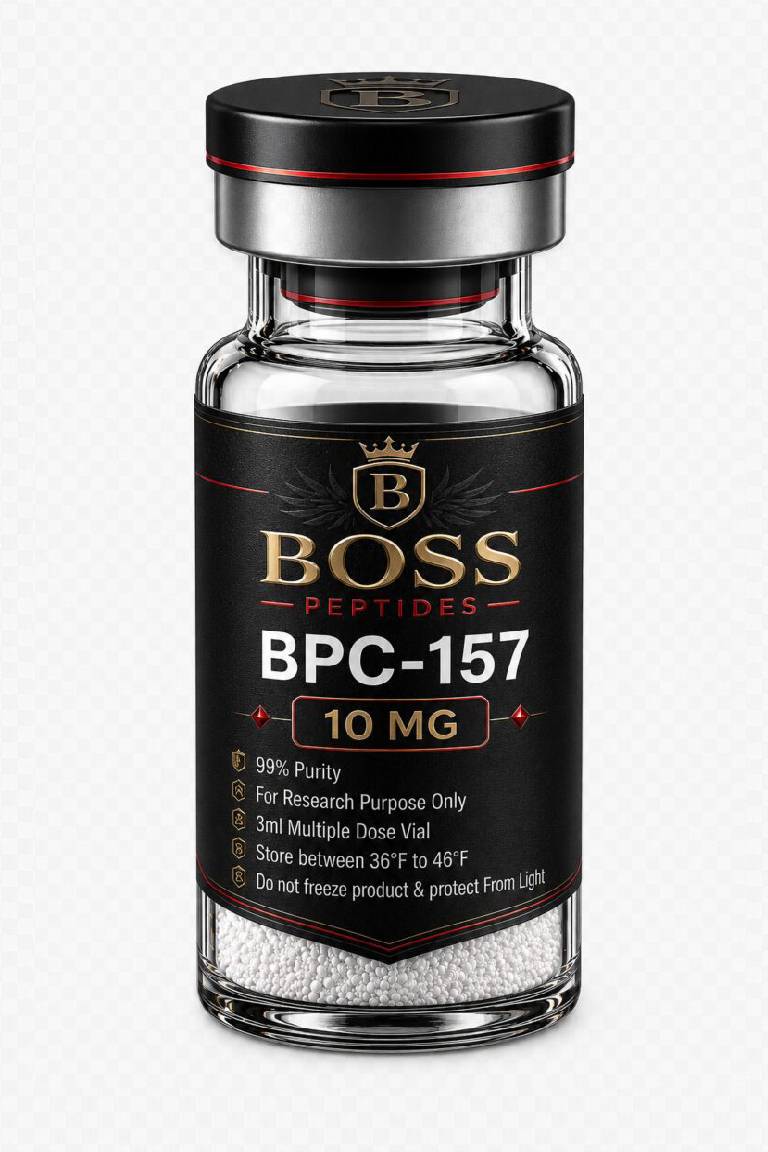
Boss Peptides (bosspeptide.com) lists both compounds as lyophilized research reagents in the Tissue-Model Research category: BPC-157 10 mg, TB-500 10 mg, and a BPC-157 10 mg + TB-500 10 mg blend. Those listings are for laboratory research use only. Longer research overviews are already on the site for BPC-157 and TB-500.
Why this comparison comes up in research
Laboratories that work with tissue, cell-migration, or cytoskeletal models sometimes need to keep these two reagents distinct. They differ in chain length, origin, and the kind of published record attached to each name. BPC-157 has a comparatively large preclinical literature of its own. Much of the biology published under the heading “thymosin beta-4” concerns the 43-residue parent, not the seven-residue fragment sold under the TB-500 name. A comparison that starts with structure and with the model used in each paper is more useful than a comparison that treats the two catalog names as interchangeable tools.
This page stays with those structural differences and with a short account of what selected papers measured. It does not convert a table into a protocol, and it does not tell a reader which material to choose for any use outside a laboratory.
Comparison at a glance
Values below are for the free peptides as recorded in public registries, not for a salt form or a specific lot. Confirm sequence and observed mass on the lot documents for the vial in hand.
| Item | BPC-157 | TB-500 (Ac-LKKTETQ fragment) |
|---|---|---|
| What it is | Synthetic 15-residue peptide (pentadecapeptide) | Catalog name usually attached to the N-acetylated 17–23 fragment of thymosin beta-4 |
| Sequence | GEPPPGKPADDAGLV (H-Gly-Glu-Pro-Pro-Pro-Gly-Lys-Pro-Ala-Asp-Asp-Ala-Gly-Leu-Val-OH) | Ac-Leu-Lys-Lys-Thr-Glu-Thr-Gln-OH (Ac-LKKTETQ) |
| Residues | 15; free N-terminus; free C-terminal acid | 7; N-terminal acetyl; free C-terminal acid |
| Molecular formula (free peptide) | C62H98N16O22 | C38H68N10O14 |
| Average molecular weight | 1419.5 g/mol (PubChem CID 9941957) | 889.0 g/mol (PubChem CID 62707662) |
| CAS Registry Number | 137525-51-0 | 885340-08-9 for this fragment (full-length thymosin beta-4 is 77591-33-4) |
| Typical research literature | Preclinical cell, explant, and animal models attributed to BPC-157 itself | Analytical papers on the fragment; much of the biology literature concerns full-length thymosin beta-4 |
| Listed on this site | Yes — research reagent only | Yes — research reagent only |
Full-length thymosin beta-4 is not the same molecule as the fragment in that table. PubChem records the parent as a 43-residue chain with an average molecular weight of about 4,963 g/mol (CID 16132341). Do not treat a paper on the parent as a paper on the fragment.
BPC-157: structure and what published studies have examined
Chemically, BPC-157 is a defined 15-residue sequence produced by synthesis. Public records list the one-letter sequence GEPPPGKPADDAGLV, the formula C62H98N16O22, and an average molecular weight of 1419.5 g/mol (PubChem CID 9941957; CAS 137525-51-0). A 1993 overview by Sikiric and colleagues is often cited as an early description of material from that gastric-juice work. Later papers describe BPC-157 as a discrete synthetic peptide rather than a purified natural drug product.
The published experimental literature is almost entirely preclinical. A 2025 systematic review by Vasireddi and colleagues found 36 studies that met its criteria; 35 were laboratory or animal studies. The review did not identify a controlled human study or a safety data set that would support an approved use (Vasireddi et al., 2025). McGuire and colleagues (2025) likewise described the literature outside laboratory and animal models as extremely limited and characterized the compound as investigational. Józwiak and colleagues (2025) noted that it has not been approved by the U.S. Food and Drug Administration or by other major regulatory authorities.
One frequently cited laboratory paper is Chang and colleagues (2011). Working with rat Achilles tendon explants and cultured tendon fibroblasts, the authors reported faster outgrowth of fibroblasts from explants, greater cell survival under hydrogen-peroxide stress, and increased migration and spreading in culture, together with increased phosphorylation of FAK and paxillin. Those findings are in vitro and ex vivo results in a rat tendon system. They are laboratory results only, and they are not results for a catalog vial.
Later reviews have organized proposed mechanisms around pathways measured in animal and cell papers, including angiogenesis-related signaling such as VEGFR2 and the Akt–eNOS axis, and ERK1/2 signaling (McGuire et al., 2025). That is a map of what experimentalists have measured in those models. It is not a claim about an effect in people, and it is not a specification for a research reagent.
TB-500: the fragment, the parent, and the naming problem
TB-500 is a trade name. A 2012 analytical paper by Esposito and colleagues identified the N-terminal acetylated 17–23 fragment of thymosin beta-4, Ac-LKKTETQ, in a product sold under that name (Esposito et al., 2012). PubChem CID 62707662 and the FDA UNII QHK6Z47GTG record that fragment under the name TB-500, with CAS 885340-08-9, formula C38H68N10O14, and an average molecular weight of 889.0 g/mol. A separate analytical method paper treated TB-500 as a synthetic version of an active region of thymosin beta-4 (Ho et al., 2012).
Full-length thymosin beta-4 is a 43-residue, N-acetylated peptide that has been studied as an actin-binding and actin-sequestering molecule (Safer et al., 1991). The seven-residue stretch LKKTETQ sits inside that chain (residues 17–23). Because vendors sometimes use “TB-500” for either substance, the lot Certificate of Analysis must confirm which material is in the vial. This page uses the Ac-LKKTETQ fragment as the usual reference set for the catalog name, matching the TB-500 research overview.
Fragment-specific biology is thinner than the parent-peptide literature. Philp and colleagues (2003) tested full-length thymosin beta-4 and a synthetic peptide containing the actin-binding domain in dermal wound models in diabetic and aged mice. That paper is useful evidence that a short peptide from this region can be studied on its own. It is still an animal-model result, and it does not establish that a marketed TB-500 preparation is identical to the tested peptide.
A head-to-head animal model, and what it does not settle
A 2026 rat study examined BPC-157, a material the authors described as “synthetic thymosin beta-4 (TB-500),” and the two together, in a standardized Achilles tendon transection-and-repair model (Biçer et al., 2026). The authors reported biomechanical and histopathological endpoints at four weeks. In that experiment, the group they labeled TB-500 reached statistical significance on maximum load to failure relative to controls, and selected histology scores were lower (that is, closer to the scoring systems’ description of more organized tendon architecture) in that group and in the combination group. The BPC-157 group showed numerically lower histology scores that did not reach statistical significance for the total scores. The authors also reported that the combination did not add an effect beyond either compound alone in that model.
Those are findings in one exploratory rat model, at one time point, with the identities and preparations used by that laboratory. The paper’s own wording, “synthetic thymosin beta-4 (TB-500),” does not by itself establish that the material was the Ac-LKKTETQ fragment listed in public registries under that name. The results should not be read as a ranking of the two catalog items, as an effect in people, or as evidence that a two-peptide blend is a validated combination. They do illustrate why identity matters: if a paper uses “TB-500” for a full-length or otherwise different chain, its results should not be read across to an Ac-LKKTETQ fragment, or the other way around.
What this comparison is not
This page does not:
- rank the two peptides by “result,” “strength,” or any other outcome
- specify an amount, a schedule, or a route of use
- tell a laboratory or a reader which compound to select for use in people or animals
- treat a paper on full-length thymosin beta-4 as a paper on the TB-500 fragment
- present either research reagent as a finished medicine
- describe a two-peptide blend as a validated combination protocol
Neither compound is an FDA-approved drug product. In sport, the World Anti-Doping Agency’s 2026 Prohibited List names BPC-157 as an example in class S0, “Non-Approved Substances.” A research-use listing is not an approval, and it is not a statement about eligibility in competition. See the BPC-157 research overview for a longer account of that point.
Laboratory handling and storage
If you are holding BPC-157 or TB-500 as a laboratory reagent, storage and handling should follow the lot documents and standard practice for lyophilized peptides. A separate guide, How to Store Peptides in the Lab, covers arrival checks, temperature, moisture, light, aliquots, and what changes once a protocol requires the material in solution. Confirm the sequence and observed mass on the lot documents, especially for any material labeled TB-500.
Related research materials listed on this site
Boss Peptides lists the following lyophilized research reagents in Tissue-Model Research:
See also the BPC-157 research overview and the TB-500 research overview. All listings are for laboratory research use only.
Frequently asked questions
What is the main chemical difference between BPC-157 and TB-500?
BPC-157 is a 15-residue synthetic peptide (GEPPPGKPADDAGLV; average molecular weight 1419.5 g/mol). The name TB-500 is usually attached to a seven-residue, N-acetylated fragment of thymosin beta-4, Ac-LKKTETQ (average molecular weight 889.0 g/mol). Full-length thymosin beta-4 is a different, 43-residue molecule.
Are the two peptides the same, or interchangeable in a protocol?
No. They differ in sequence, length, and the literature attached to each name. A protocol should specify the chemical identity, not only the catalog name.
Does a thymosin beta-4 paper apply to a TB-500 fragment vial?
Not automatically. Most published biology on thymosin beta-4 concerns the 43-residue parent. The lot documents should be checked to confirm which chain is in the vial, and the paper should be checked to confirm which chain was studied.
Does this page recommend one compound, or the blend, over the other?
No. It compares structure and selected published models. It does not rank outcomes and it does not provide a use protocol.
Are these vials finished medicines?
No. They are lyophilized research reagents. Neither compound is an FDA-approved drug product.
Research-use limitation
All Boss Peptides catalog items are sold for laboratory research use only. They are not for human or animal consumption, not for diagnostic use, and not for administration to people or animals. They are not drugs, foods, dietary supplements, or cosmetics, and they are not intended to diagnose, treat, cure, or prevent any disease. See the RUO statement, the disclaimer, and About Boss Peptides.
Sources
PubMed and registry links below were checked on 23 November 2026. Where a publisher page blocks automated retrieval, the PubMed record is the link used here.
Chang, C. H., Tsai, W. C., Lin, M. S., Hsu, Y. H., & Pang, J. H. (2011). The promoting effect of pentadecapeptide BPC 157 on tendon healing involves tendon outgrowth, cell survival, and cell migration. Journal of Applied Physiology, 110(3), 774–780. https://pubmed.ncbi.nlm.nih.gov/21030672/
Esposito, S., Deventer, K., Goeman, J., Van der Eycken, J., & Van Eenoo, P. (2012). Synthesis and characterization of the N-terminal acetylated 17-23 fragment of thymosin beta 4 identified in TB-500, a product suspected to possess doping potential. Drug Testing and Analysis, 4(9), 733–738. https://pubmed.ncbi.nlm.nih.gov/22962027/
Ho, E. N., Kwok, W. H., Lau, M. Y., Wong, A. S., Wan, T. S., Lam, K. K., Schiff, P. J., & Stewart, B. D. (2012). Doping control analysis of TB-500, a synthetic version of an active region of thymosin β4, in equine urine and plasma by liquid chromatography–mass spectrometry. Journal of Chromatography A, 1265, 57–69. https://pubmed.ncbi.nlm.nih.gov/23084823/
Józwiak, M., Bauer, M., Kamysz, W., & Kleczkowska, P. (2025). Multifunctionality and possible medical application of the BPC 157 peptide—literature and patent review. Pharmaceuticals, 18(2), 185. https://pubmed.ncbi.nlm.nih.gov/40005999/
McGuire, F. P., Martinez, R., Lenz, A., Skinner, L., & Cushman, D. M. (2025). Regeneration or risk? A narrative review of BPC-157 for musculoskeletal healing. Current Reviews in Musculoskeletal Medicine, 18(12), 611–619. https://pubmed.ncbi.nlm.nih.gov/40789979/
Philp, D., Badamchian, M., Scheremeta, B., Nguyen, M., Goldstein, A. L., & Kleinman, H. K. (2003). Thymosin beta 4 and a synthetic peptide containing its actin-binding domain promote dermal wound repair in db/db diabetic mice and in aged mice. Wound Repair and Regeneration, 11(1), 19–24. https://pubmed.ncbi.nlm.nih.gov/12581423/
PubChem CID 62707662 (TB-500 / Ac-LKKTETQ). https://pubchem.ncbi.nlm.nih.gov/compound/62707662
PubChem CID 9941957 (BPC-157). https://pubchem.ncbi.nlm.nih.gov/compound/9941957
PubChem CID 16132341 (thymosin beta-4 / timbetasin). https://pubchem.ncbi.nlm.nih.gov/compound/16132341
Safer, D., Elzinga, M., & Nachmias, V. T. (1991). Thymosin beta 4 and Fx, an actin-sequestering peptide, are indistinguishable. Journal of Biological Chemistry, 266(7), 4029–4032. https://pubmed.ncbi.nlm.nih.gov/1999398/
Sikiric, P., Petek, M., Rucman, R., Seiwerth, S., Grabarevic, Z., Rotkvic, I., Turkovic, B., Jagic, V., Mildner, B., Duvnjak, M., & Lang, N. (1993). A new gastric juice peptide, BPC. An overview of the stomach-stress-organoprotection hypothesis and beneficial effects of BPC. Journal of Physiology (Paris), 87(5), 313–327. https://pubmed.ncbi.nlm.nih.gov/8298610/
Vasireddi, N., Hahamyan, H., Salata, M. J., Karns, M., Calcei, J. G., Voos, J. E., & Apostolakos, J. M. (2025). Emerging use of BPC-157 in orthopaedic sports medicine: A systematic review. HSS Journal. https://pubmed.ncbi.nlm.nih.gov/40756949/
Biçer, O., Adanır, O., Güleryüz, Y., Balcı, E. C., Dinçel, Y. M., Yenigün, M. Y., Aydın, C., & Yaprak Bayrak, B. (2026). Effects of BPC-157 and TB-500 on Achilles tendon healing in rats: A histopathological and biomechanical study. Joint Diseases and Related Surgery, 37(3). https://pubmed.ncbi.nlm.nih.gov/42542926/ (journal full text: https://jointdrs.org/full-text/1851)