
Sub-Total: $0.00
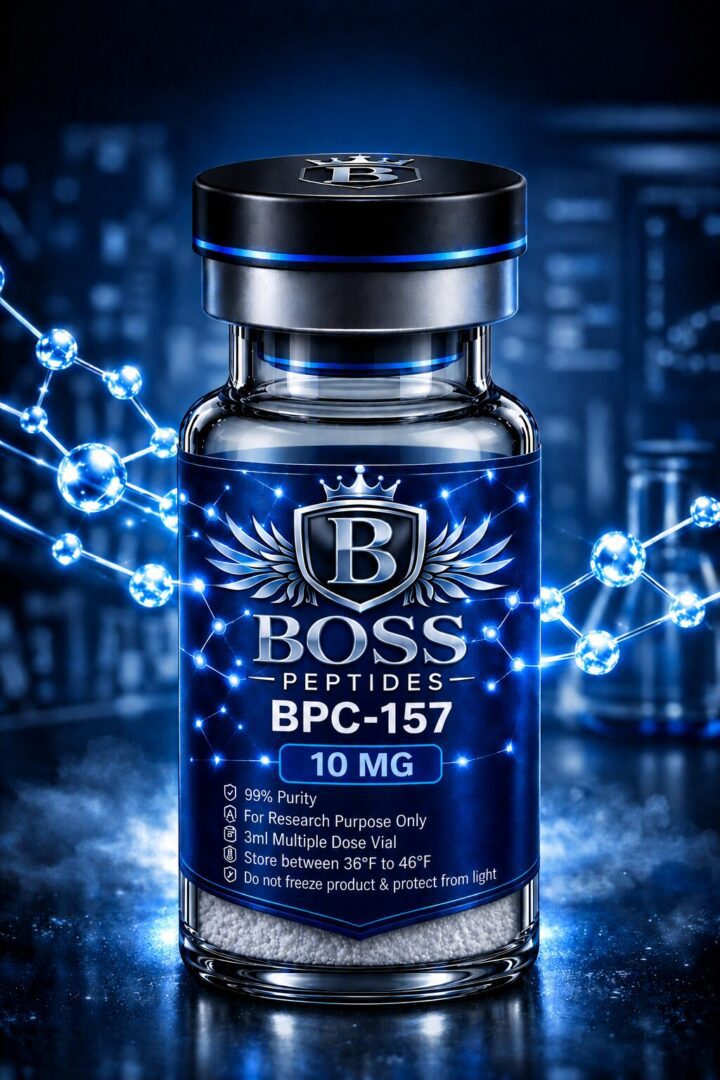
For laboratory research use only. Not for human or animal consumption. This is a research overview of BPC-157 as a laboratory compound. It is not medical advice or a use protocol, and not a claim that BPC-157 is safe, effective, or approved for people or for animals used as patients.
BPC-157 is a synthetic pentadecapeptide, a 15-amino-acid chain, whose sequence is taken from a fragment originally described in human gastric juice. Papers often write it as BPC 157, BPC-157, or “body protection compound-157,” a name that reflects an early acronym rather than an established medical classification. Researchers have studied the compound for more than three decades, almost entirely in cells, isolated tissues, and animal models.
This BPC-157 research overview is for laboratory readers who want a careful account of what that literature covers, and what it does not. Boss Peptides (bosspeptide.com) offers BPC-157 as a research reagent, including BPC-157 10 mg, a BPC-157 and TB-500 research combination, and TB-500 10 mg, listed with other items in the tissue-model research category. Those products are for laboratory research use only.
What the compound is, and what it is not
Chemically, BPC-157 is a defined peptide sequence produced by synthesis to match the fragment described in the early gastric-juice work. A 1993 overview by Sikiric and colleagues is often cited as an early description of that material, and later papers describe BPC-157 as a discrete synthetic peptide rather than a purified natural drug product.
That origin story is sometimes used as if it settled the compound’s legal or regulatory status. It does not. BPC-157 is not approved by the U.S. Food and Drug Administration, and it is not an approved drug in other major regulatory systems either (Józwiak et al., 2025). A research-use reagent is not a drug product.
What preclinical studies have examined
The published experimental literature is large and wide-ranging. Authors have used BPC-157 in laboratory models of gastrointestinal injury, experimentally induced tendon, ligament, muscle, or bone damage, ischemia–reperfusion, and in vitro fibroblast assays. A 2025 systematic review found 36 studies that met its criteria; 35 were preclinical laboratory or animal studies (Vasireddi et al., 2025).
One frequently cited laboratory paper is Chang and colleagues (2011). Working with rat Achilles tendon explants and cultured tendon fibroblasts, the authors reported that BPC-157 was associated with faster outgrowth of fibroblasts from explants, greater cell survival under hydrogen-peroxide stress, and increased migration and spreading in culture. They also reported increased phosphorylation of FAK and paxillin, proteins involved in cell adhesion and motility. Those findings are in vitro and ex vivo results in a rat tendon system, and they are laboratory results only.
Later reviews have organized proposed mechanisms around pathways measured in those animal and cell papers, including VEGFR2, the Akt–eNOS axis, and ERK1/2 signaling (McGuire et al., 2025). That is a map of what experimentalists have measured in laboratory models.
Scope of the published literature
The reviews cited here agree that almost all published work on BPC-157 uses cells, isolated tissues, or animal models.
Vasireddi and colleagues (2025) found only one report in their set that was not a laboratory or animal study, a small retrospective case series. The review did not identify a controlled study or a safety data set for the compound.
McGuire and colleagues (2025) likewise described the literature outside laboratory and animal models as extremely limited and characterized BPC-157 as investigational. Józwiak and colleagues (2025) noted that the compound has not been approved by the FDA or other regulatory authorities.
The U.S. Anti-Doping Agency also states that BPC-157 is not an approved substance (USADA).
A long preclinical record does not establish any approved use.
Regulatory status, including sport
Two questions are often mixed together: whether a compound is an approved medicine, and whether it is allowed in competitive sport. BPC-157 is not an FDA-approved drug, and the reviews above also note that it is not approved by other major regulatory authorities. In sport, the World Anti-Doping Agency’s 2026 Prohibited List names BPC-157 as an example in class S0, “Non-Approved Substances,” which is prohibited at all times, in and out of competition. USADA describes the same S0 classification. One 2025 review suggested that a WADA listing had been temporary; that description does not match the 2026 List or USADA’s current public advice. “Sold for research” does not mean “approved.”
How to read vendor pages, including this one
A research overview can name the models used, cite the papers, and state the limits of the published record. It does not describe any use outside the laboratory.
If you are holding BPC-157 as a laboratory reagent, storage and handling should follow the lot documents and standard practice for lyophilized peptides. A separate guide, how to store peptides in the lab, covers temperature, moisture, light, and aliquots. The KLOW blend research overview describes a lyophilized research blend that includes BPC-157 together with GHK-Cu, TB-500, and KPV. See also the RUO statement, the disclaimer, and About Boss Peptides.
Specifications
Values below are for the free peptide as recorded in PubChem, not for a salt form or a specific lot. A Certificate of Analysis, when provided for a lot, is the source for that lot’s observed mass and salt form.
| Compound | BPC-157 (also written BPC 157, bepecin, PL 14736) |
|---|---|
| CAS Registry Number | 137525-51-0 (PubChem CID 9941957; also listed by ChemIDplus and DrugBank on that record) |
| Sequence (one-letter) | GEPPPGKPADDAGLV |
| Sequence (three-letter) | H-Gly-Glu-Pro-Pro-Pro-Gly-Lys-Pro-Ala-Asp-Asp-Ala-Gly-Leu-Val-OH |
| Residues | 15 (pentadecapeptide); free N-terminus; free C-terminal acid |
| Molecular formula | C62H98N16O22 (free peptide) |
| Average molecular weight | 1419.5 g/mol (PubChem, computed) |
| Monoisotopic mass | 1418.70415882 Da (PubChem, computed) |
| InChIKey | HEEWEZGQMLZMFE-RKGINYAYSA-N |
| Form sold here | Lyophilized powder in a sealed laboratory vial |
| Sizes in this catalog | 10 mg (single compound). Also a blend vial with 10 mg BPC-157 plus 10 mg TB-500. |
| Storage | See storage notes below. Follow the lot documents first. |
Sizes in the Boss Peptides catalog
- BPC-157 10MG — 10 mg lyophilized powder, SKU BOSS-BPC-157-001
- BPC-157 10MG + TB-500 10MG (20MG blend) — 10 mg of each compound in one vial, SKU BOSS-BPC-TB-20MG-001
Related reading: TB-500 research overview and the KLOW Peptide Blend article (KLOW contains BPC-157).
Storage notes
Follow the storage line on the lot documents and the vial label first. The shop’s storage guide for lyophilized research materials recommends keeping the dry cake tightly closed, dry, and protected from light; about −20 °C for routine or medium-term storage of the dry cake; and about −80 °C when a lot is held for the long term. Refrigerator temperature (about 4 °C) is described there as a short holding condition only, and only when the lot documents allow it. Let a cold, sealed vial reach room temperature in a dry environment before opening it, to limit condensation on the cake. Avoid repeated freeze–thaw cycles once a solution is prepared. See How to Store Peptides in the Lab.
Sources
PubMed and PMC links below were checked on 19 November 2026.
- Chang, C. H., Tsai, W. C., Lin, M. S., Hsu, Y. H., & Pang, J. H. (2011). The promoting effect of pentadecapeptide BPC 157 on tendon healing involves tendon outgrowth, cell survival, and cell migration. Journal of Applied Physiology, 110(3), 774–780. https://pubmed.ncbi.nlm.nih.gov/21030672/
- Vasireddi, N., Hahamyan, H., Salata, M. J., Karns, M., Calcei, J. G., Voos, J. E., & Apostolakos, J. M. (2025). Emerging use of BPC-157 in orthopaedic sports medicine: A systematic review. HSS Journal. https://pubmed.ncbi.nlm.nih.gov/40756949/
- McGuire, F. P., Martinez, R., Lenz, A., Skinner, L., & Cushman, D. M. (2025). Regeneration or risk? A narrative review of BPC-157 for musculoskeletal healing. Current Reviews in Musculoskeletal Medicine, 18(12), 611–619. https://pubmed.ncbi.nlm.nih.gov/40789979/
- Józwiak, M., Bauer, M., Kamysz, W., & Kleczkowska, P. (2025). Multifunctionality and possible medical application of the BPC 157 peptide—literature and patent review. Pharmaceuticals, 18(2), 185. https://pubmed.ncbi.nlm.nih.gov/40005999/ (open access: PMC11859134)
- U.S. Anti-Doping Agency. BPC-157: Experimental peptide creates risk for athletes. https://www.usada.org/spirit-of-sport/bpc-157-peptide-prohibited/. See also the WADA 2026 Prohibited List, class S0.
Products from Boss Peptides (bosspeptide.com) are for laboratory research use only. They are not medicines, supplements, or foods, and they are not for human or animal consumption.