
Sub-Total: $0.00
TB-500 Research Overview
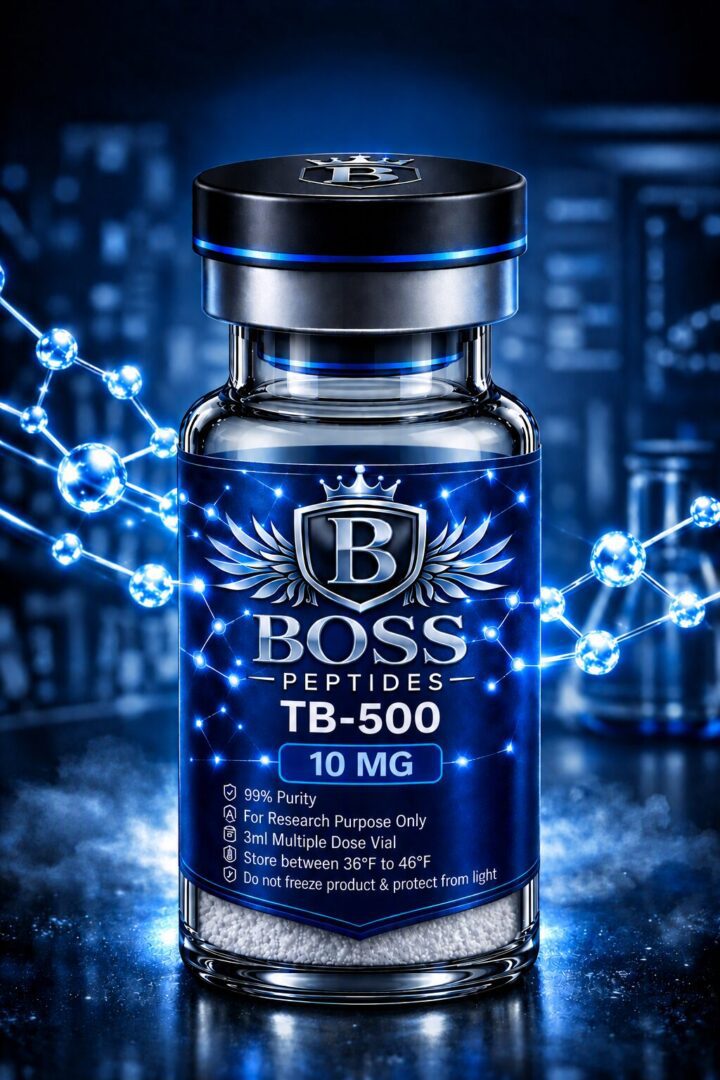
This page is the research hub for the catalog name TB-500 at Boss Peptides (bosspeptide.com). It explains the naming problem, gives identifiers for the fragment most often attached to that name, and links to the sizes in the catalog. The material is sold for laboratory research use only.
Specifications and a naming caution
TB-500 is a trade name, not a unique chemical specification by itself. A 2012 analytical paper identified the N-terminal acetylated 17–23 fragment of thymosin beta-4, Ac-LKKTETQ, in a product sold as TB-500 (PMID 22962027). PubChem CID 62707662 and FDA UNII QHK6Z47GTG record that fragment under the name TB-500, with CAS 885340-08-9. Full-length thymosin beta-4 is a 43-residue chain (CAS 77591-33-4, average molecular weight about 4963 g/mol) and is not the same molecule.
Because vendors sometimes use “TB-500” for either substance, this table lists fragment identifiers as the usual reference set for the name, and lists the parent-peptide CAS only so the two are not confused. Do not treat a CAS as confirmed for a given vial until the lot Certificate of Analysis states the sequence and mass.
| Catalog name | TB-500 |
|---|---|
| What the name refers to | A trade name. In analytical literature and in FDA GSRS / PubChem, it is attached to the N-acetylated heptapeptide Ac-LKKTETQ (residues 17–23 of thymosin beta-4). The same name is sometimes used loosely for full-length thymosin beta-4, which is a different molecule. The lot Certificate of Analysis must confirm which material is in the vial. |
| CAS for the Ac-LKKTETQ fragment | 885340-08-9 (PubChem CID 62707662; FDA UNII QHK6Z47GTG / GSRS). This CAS identifies the fragment, not full-length thymosin beta-4. |
| CAS for full-length thymosin beta-4 (not assumed to be this vial) | 77591-33-4 (PubChem CID 16132341, timbetasin). Formula C212H350N56O78S, average MW 4963 g/mol. |
| Fragment sequence | Ac-Leu-Lys-Lys-Thr-Glu-Thr-Gln-OH (Ac-LKKTETQ) |
| Fragment residues | 7; N-terminal acetyl; free C-terminal acid |
| Fragment molecular formula | C38H68N10O14 |
| Fragment average molecular weight | 889.0 g/mol (PubChem, computed) |
| Fragment monoisotopic mass | 888.49164688 Da (PubChem, computed) |
| Form sold here | Lyophilized powder in a sealed laboratory vial |
| Sizes in this catalog | 10 mg (single compound). Also a blend vial with 10 mg TB-500 plus 10 mg BPC-157. |
| Storage | See storage notes below. Follow the lot documents first. |
Sizes in the Boss Peptides catalog
- TB-500 10MG — 10 mg lyophilized powder, SKU BOSS-TB-500-001
- BPC-157 10MG + TB-500 10MG (20MG blend) — 10 mg of each compound in one vial, SKU BOSS-BPC-TB-20MG-001
Related catalog group: Tissue-Model Research.
Related reading: BPC-157 research overview and the KLOW Peptide Blend article (KLOW also lists a TB-500 component).
Storage notes
Follow the storage line on the lot documents and the vial label first. The shop’s storage guide for lyophilized research materials recommends keeping the dry cake tightly closed, dry, and protected from light; about −20 °C for routine or medium-term storage of the dry cake; and about −80 °C when a lot is held for the long term. Refrigerator temperature (about 4 °C) is described there as a short holding condition only, and only when the lot documents allow it. Let a cold, sealed vial reach room temperature in a dry environment before opening it, to limit condensation on the cake. Avoid repeated freeze–thaw cycles once a solution is prepared. See How to Store Peptides in the Lab.
Literature summary
Thymosin beta-4 is a 43-residue, N-acetylated peptide that has been studied as an actin-binding molecule in biochemical work (PMID 1999398). The seven-residue stretch LKKTETQ sits inside that chain (residues 17–23). Analytical papers on products labeled TB-500 have reported the N-acetylated fragment Ac-LKKTETQ rather than the full 43-residue chain (PMID 22962027, PMID 23084823).
Most published biology on “thymosin beta-4” concerns the full-length parent, not the isolated heptapeptide. Findings in those papers should not be read across to a fragment vial, and none of them are results for this product.
Research-use limitation
For laboratory research use only. Not for human or animal consumption. This material is not a drug, food, dietary supplement, or cosmetic, and it is not intended to diagnose, treat, cure, or prevent any disease. Boss Peptides (bosspeptide.com) does not provide human or veterinary use guidance. Information on this page summarizes published literature and reference identifiers for scientific and educational use. It is not a claim about the effects of this product.
Sources
- PubChem CID 62707662 — title/synonyms include TB-500 and Ac-Leu-Lys-Lys-Thr-Glu-Thr-Gln-OH; CAS 885340-08-9; formula C38H68N10O14; average MW 889.0 g/mol. Retrieved November 20, 2026.
- FDA UNII QHK6Z47GTG (TB-500) — preferred name TB-500; CAS 885340-08-9; describes the N-terminal acetylated 17–23 fragment of thymosin beta-4.
- PubChem CID 16132341, timbetasin / thymosin beta-4 — CAS 77591-33-4; formula C212H350N56O78S; average MW 4963 g/mol.
- Esposito et al., Drug Test. Anal. 2012; PMID 22962027 — synthesis and characterization of the N-terminal acetylated 17–23 fragment identified in a product labeled TB-500.
- Ho et al., J. Chromatogr. A 2012; PMID 23084823 — analytical method paper treating TB-500 as a synthetic version of an active region of thymosin β4.
- Safer et al., J. Biol. Chem. 1991; PMID 1999398 — thymosin beta-4 as an actin-sequestering peptide (parent molecule, not the fragment).
- Boss Peptides, How to Store Peptides in the Lab.