Sub-Total: $0.00
MOTS-C Benefits: Cellular Metabolism, Mitochondrial Function and Insulin Sensitivity Research

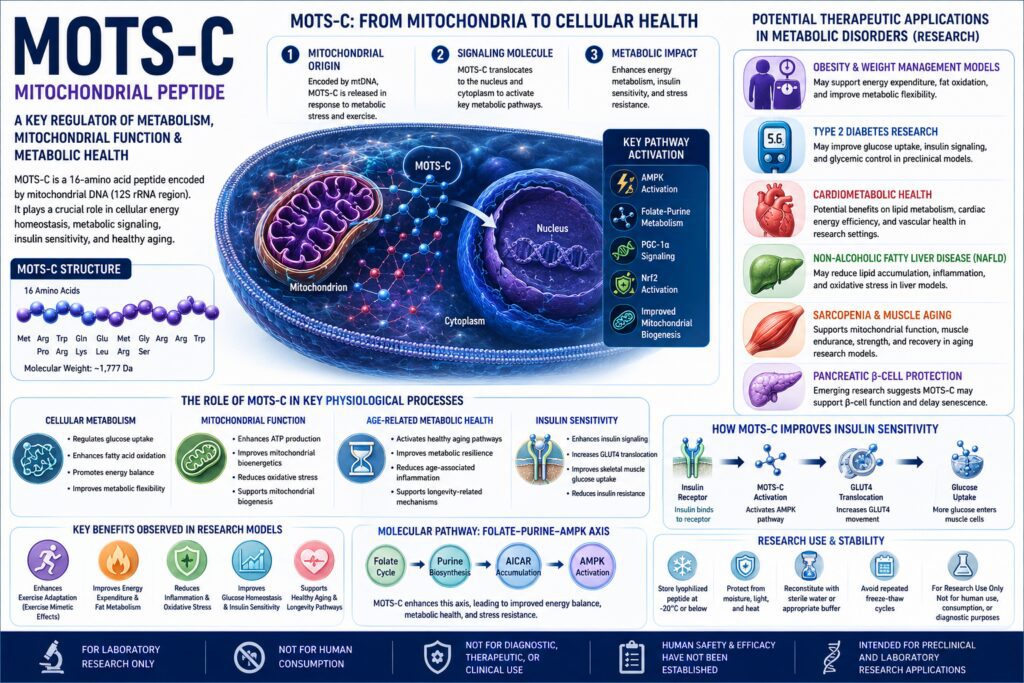
The Role of MOTS-C in Cellular Metabolism, Mitochondrial Function, Age-Related Metabolic Health, and Insulin Sensitivity
Introduction
MOTS-C has become one of the most discussed mitochondrial-derived peptides in modern metabolic and longevity research. Unlike traditional peptides encoded by nuclear DNA, MOTS-C is encoded within mitochondrial DNA, giving it a unique position in the study of mitochondrial signaling, cellular energy balance, metabolic adaptation, and age-related physiological decline.
The growing search interest around terms like “MOTS-C benefits,” “MOTS-C peptide,” “MOTS-C mitochondrial function,” and “MOTS-C insulin sensitivity” reflects the increasing attention this peptide receives in wellness, longevity, metabolic health, and research peptide communities. However, it is important to separate scientific research from approved clinical use. MOTS-C remains an investigational research peptide and should be discussed as a research-use-only compound, not as an approved treatment, medication, supplement, or therapy.
Research interest in MOTS-C is primarily centered on five major areas: cellular metabolism, mitochondrial function, age-related metabolic health, metabolic disorder models, and insulin sensitivity. These areas are deeply connected because mitochondria regulate how cells produce energy, respond to stress, process nutrients, and maintain metabolic flexibility. When mitochondrial function declines, cells may become less efficient at using glucose and fatty acids, inflammation may increase, and age-related metabolic dysfunction may become more pronounced.
This paper explores the role of MOTS-C in cellular metabolism, how MOTS-C influences mitochondrial function, the connection between MOTS-C and age-related metabolic health, potential therapeutic applications of MOTS-C in metabolic disorder research, and MOTS-C’s impact on insulin sensitivity.
1. What Is MOTS-C?
MOTS-C stands for mitochondrial open reading frame of the 12S rRNA type-c. It is a small mitochondrial-derived peptide composed of 16 amino acids. MOTS-C is encoded in the mitochondrial genome, which makes it especially important in the study of mitochondrial communication and cellular energy regulation.
Mitochondria are often called the powerhouses of the cell because they produce ATP, the primary energy currency used by cells. However, modern research has shown that mitochondria do much more than generate energy. They also send signals that affect inflammation, stress response, metabolism, cellular repair, and aging. MOTS-C is one of the mitochondrial-derived peptides believed to participate in this communication network.
MOTS-C is studied for its potential influence on:
- Cellular metabolism
- Mitochondrial signaling
- Glucose metabolism
- Insulin sensitivity
- AMPK activation
- Metabolic flexibility
- Oxidative stress response
- Inflammation modulation
- Age-related metabolic decline
- Muscle energy metabolism
- Longevity-related cellular pathways
Because of these research areas, MOTS-C has become a major topic in mitochondrial peptide research and longevity-focused metabolic science.
2. The Role of MOTS-C in Cellular Metabolism
Cellular metabolism refers to the chemical processes cells use to convert nutrients into energy, build essential molecules, remove waste, and adapt to changing energy demands. MOTS-C is strongly connected to cellular metabolism because it appears to influence how cells sense energy availability and respond to metabolic stress.
One of the most important pathways linked to MOTS-C is the AMPK pathway. AMPK, or AMP-activated protein kinase, is often described as a master energy sensor. When cellular energy is low, AMPK becomes activated and helps shift the cell toward energy-producing activity. This includes increasing glucose uptake, supporting fatty acid oxidation, improving mitochondrial efficiency, and reducing energy-consuming processes that are not immediately necessary.
MOTS-C research suggests that this peptide may regulate metabolism through the folate-purine-AMPK pathway. This is important because folate metabolism and purine biosynthesis are connected to nucleotide production, energy sensing, methylation, and cellular growth. By influencing these pathways, MOTS-C may help cells detect metabolic stress and adjust energy use accordingly.
In metabolic research, MOTS-C is often studied in relation to:
- Glucose uptake
- Fatty acid oxidation
- Energy balance
- Nutrient sensing
- Skeletal muscle metabolism
- Cellular stress adaptation
- Metabolic flexibility
- Insulin-response pathways
Metabolic flexibility is especially important. A metabolically flexible cell can switch efficiently between fuel sources, such as glucose and fatty acids, depending on energy demand and nutrient availability. Loss of metabolic flexibility is often associated with obesity, insulin resistance, type 2 diabetes models, and age-related metabolic decline. MOTS-C is relevant because it appears to interact with the cellular pathways that help regulate this fuel-switching process.
In simple terms, MOTS-C is being researched as a peptide that may help cells respond more intelligently to energy demand. It does not simply “increase energy” in a generic way. Instead, its scientific importance comes from its potential role in cellular energy regulation, metabolic stress response, and mitochondrial-to-nuclear communication.
3. How MOTS-C Influences Mitochondrial Function
Mitochondrial function is central to cellular health. Healthy mitochondria produce ATP efficiently, regulate oxidative stress, support calcium balance, participate in cell survival signaling, and communicate with the nucleus. When mitochondrial function declines, cells may experience reduced energy production, increased oxidative stress, impaired metabolism, and reduced resilience.
MOTS-C is important because it is part of the emerging category of mitochondrial-derived peptides. These peptides suggest that mitochondria are not only energy-producing organelles but also signaling centers. MOTS-C appears to help transmit information from mitochondria to other parts of the cell, including the nucleus.
One of the major ways MOTS-C may influence mitochondrial function is through AMPK-related signaling. AMPK activation is associated with improved energy balance, increased fatty acid oxidation, enhanced glucose uptake, and mitochondrial biogenesis. Mitochondrial biogenesis refers to the creation of new mitochondria, which can support improved cellular energy capacity and metabolic resilience.
MOTS-C research has also been connected to PGC-1α, a major regulator of mitochondrial biogenesis and oxidative metabolism. PGC-1α helps coordinate the expression of genes involved in mitochondrial function, energy production, and endurance-related adaptations. This is one reason MOTS-C is often discussed in connection with exercise-like signaling and skeletal muscle metabolism.
MOTS-C may influence mitochondrial function through several research-relevant mechanisms:
3.1 Mitochondrial Bioenergetics
Bioenergetics refers to how cells produce, transfer, and use energy. MOTS-C is being studied for its potential to support mitochondrial bioenergetic efficiency in experimental models. This includes research into ATP production, oxygen consumption, and mitochondrial respiratory capacity.
3.2 Mitochondrial Stress Response
Mitochondria are highly sensitive to stress. Nutrient overload, inflammation, oxidative stress, aging, and metabolic dysfunction can all impair mitochondrial performance. MOTS-C appears to be involved in stress-response signaling, helping researchers explore how cells adapt to metabolic challenge.
3.3 Mitochondrial-Nuclear Communication
Although MOTS-C is encoded by mitochondrial DNA, it can influence nuclear gene expression under certain cellular conditions. This is important because many mitochondrial proteins are actually encoded by nuclear DNA. Communication between mitochondria and the nucleus helps maintain energy balance, stress adaptation, and cellular repair.
3.4 Oxidative Stress Regulation
Mitochondria are a major source of reactive oxygen species. While controlled amounts of reactive oxygen species are useful for signaling, excessive oxidative stress can damage proteins, lipids, DNA, and mitochondria themselves. MOTS-C is being studied in models involving oxidative stress and cellular protection pathways.
3.5 Muscle Mitochondrial Function
Skeletal muscle is one of the most metabolically active tissues in the body. It plays a major role in glucose disposal, fatty acid oxidation, exercise adaptation, and insulin sensitivity. MOTS-C research often focuses on skeletal muscle because this tissue is central to whole-body metabolic health.
Overall, MOTS-C influences mitochondrial research because it connects energy sensing, mitochondrial adaptation, cellular stress response, and metabolic regulation.
4. The Connection Between MOTS-C and Age-Related Metabolic Health
Aging is strongly associated with changes in mitochondrial function and metabolic regulation. As organisms age, mitochondria may become less efficient, oxidative stress may increase, insulin sensitivity may decline, inflammation may become more persistent, and cells may become less adaptable to metabolic stress.
MOTS-C has attracted attention in longevity research because its expression appears to be connected with stress, exercise, and aging-related changes. Research suggests that MOTS-C may be involved in protecting against age-associated metabolic dysfunction in experimental models. This makes it an important peptide for studying the biological relationship between mitochondria, metabolism, and aging.
Age-related metabolic decline can involve:
- Reduced mitochondrial efficiency
- Lower metabolic flexibility
- Increased insulin resistance
- Higher oxidative stress
- Chronic low-grade inflammation
- Declining muscle function
- Impaired glucose metabolism
- Reduced cellular stress resilience
- Altered fat metabolism
- Decreased energy homeostasis
MOTS-C is relevant to these areas because it appears to act on pathways that influence energy balance, mitochondrial adaptation, and insulin-response mechanisms.
One important reason MOTS-C is discussed in longevity science is its connection to exercise-associated signaling. Exercise is one of the most powerful interventions known to support mitochondrial function and metabolic health. MOTS-C has been studied in relation to exercise-like pathways, especially those involving AMPK and skeletal muscle metabolism. This does not mean MOTS-C replaces exercise. Instead, it means researchers are investigating whether MOTS-C participates in some of the same cellular signaling networks activated by exercise.
In age-related metabolic health research, MOTS-C is often connected to the following themes:
4.1 Healthy Aging Pathways
MOTS-C is studied for its relationship to energy-sensing pathways that are commonly associated with healthy aging research, including AMPK activation, mitochondrial biogenesis, and stress-response signaling.
4.2 Muscle Aging
Loss of muscle function is a major feature of aging. Because skeletal muscle is central to metabolism and insulin sensitivity, MOTS-C research in muscle tissue may provide insight into age-related metabolic decline.
4.3 Metabolic Flexibility
Aging can reduce the body’s ability to switch between fuel sources. MOTS-C may help researchers understand how mitochondrial signaling contributes to metabolic flexibility.
4.4 Insulin Resistance With Age
Insulin sensitivity often declines with age, particularly when combined with obesity, inactivity, inflammation, or mitochondrial dysfunction. MOTS-C is studied because of its connection to glucose handling and insulin-response pathways.
4.5 Inflammation and Oxidative Stress
Aging is often associated with chronic low-grade inflammation and oxidative stress. MOTS-C research includes pathways that may influence cellular stress responses and inflammatory signaling.
The connection between MOTS-C and age-related metabolic health makes it a valuable research peptide for longevity-focused studies, especially those examining mitochondrial biology, skeletal muscle function, glucose metabolism, and cellular resilience.
5. Potential Therapeutic Applications of MOTS-C in Metabolic Disorder Research
MOTS-C is not an approved therapy. However, it is being studied for potential therapeutic relevance in metabolic disorder models. This distinction is important for compliance and scientific accuracy. The best wording is that MOTS-C has potential therapeutic applications under investigation, not that it is a proven treatment.
Metabolic disorders involve disruptions in how the body processes and stores energy. These may include insulin resistance, obesity, type 2 diabetes models, fatty acid metabolism problems, metabolic syndrome models, and age-related metabolic dysfunction. Because MOTS-C is involved in mitochondrial signaling and energy regulation, researchers are exploring whether it may have therapeutic potential in these areas.
5.1 Obesity and Diet-Induced Metabolic Dysfunction Models
MOTS-C has been studied in preclinical models involving diet-induced obesity and metabolic stress. Researchers are interested in whether MOTS-C can influence energy expenditure, glucose metabolism, fat metabolism, and insulin-response pathways.
5.2 Type 2 Diabetes Research Models
Type 2 diabetes is strongly linked to insulin resistance, mitochondrial dysfunction, impaired glucose metabolism, inflammation, and reduced metabolic flexibility. MOTS-C is relevant because it has been associated with improved glucose utilization and insulin sensitivity in experimental settings.
5.3 Metabolic Syndrome Research
Metabolic syndrome is a cluster of metabolic abnormalities that may include insulin resistance, abdominal obesity, abnormal lipid metabolism, and elevated inflammatory markers. Because MOTS-C research overlaps with glucose metabolism, lipid metabolism, mitochondrial function, and inflammation, it is a promising target for metabolic syndrome research models.
5.4 Cardiometabolic Research
Mitochondrial dysfunction is closely connected to cardiometabolic health. Some research has explored MOTS-C in relation to cardiac metabolism, mitochondrial respiration, and diabetic myocardial injury models. This area may become increasingly important as researchers examine the connection between metabolic disease and mitochondrial function.
5.5 Muscle Metabolism and Sarcopenia Research
Sarcopenia, or age-related muscle decline, is associated with reduced strength, impaired glucose disposal, and lower metabolic efficiency. Because MOTS-C is connected to skeletal muscle metabolism and mitochondrial bioenergetics, it may be useful in research models studying muscle aging and metabolic health.
5.6 Pancreatic β-Cell Aging Research
Pancreatic β-cells produce insulin and are central to glucose regulation. Newer research has explored MOTS-C in relation to β-cell senescence and pancreatic aging models. This area is important because β-cell dysfunction is a major contributor to type 2 diabetes progression.
While these potential applications are scientifically exciting, MOTS-C should not be marketed as a treatment for obesity, diabetes, metabolic syndrome, or aging. It remains a research peptide with investigational relevance.
6. MOTS-C’s Impact on Insulin Sensitivity
Insulin sensitivity refers to how effectively cells respond to insulin. When insulin sensitivity is high, cells can take up glucose efficiently in response to insulin signaling. When insulin sensitivity is low, the body requires more insulin to move glucose into cells, and blood glucose regulation may become impaired.
MOTS-C is strongly connected to insulin sensitivity research because of its relationship with skeletal muscle metabolism, glucose uptake, AMPK activation, and mitochondrial function. Skeletal muscle is responsible for a major portion of insulin-stimulated glucose disposal, making it a key tissue in insulin resistance research.
MOTS-C may influence insulin sensitivity through several research-relevant mechanisms:
6.1 Increased Glucose Uptake
MOTS-C research suggests that the peptide may support glucose uptake in skeletal muscle models. Improved glucose uptake is one of the most important mechanisms for better insulin-response activity.
6.2 AMPK Activation
AMPK activation can promote glucose transport and fatty acid oxidation. Because MOTS-C is associated with AMPK signaling, this pathway is central to understanding its potential effect on insulin sensitivity.
6.3 Improved Mitochondrial Efficiency
Mitochondrial dysfunction is closely associated with insulin resistance. If mitochondria are unable to efficiently process nutrients and produce energy, metabolic stress can increase. MOTS-C research suggests it may influence mitochondrial efficiency and metabolic adaptation, which may indirectly support insulin-response pathways.
6.4 Reduced Metabolic Stress
Insulin resistance is often worsened by inflammation, oxidative stress, nutrient overload, and impaired lipid metabolism. MOTS-C is studied in connection with stress-response pathways that may reduce metabolic strain in experimental models.
6.5 Skeletal Muscle Signaling
Because MOTS-C appears to target or influence skeletal muscle metabolism, it is especially relevant to insulin sensitivity research. Skeletal muscle function, mitochondrial density, and glucose uptake are major factors in whole-body metabolic health.
For SEO purposes, “MOTS-C insulin sensitivity” is one of the strongest keyword themes. However, responsible content should avoid saying “MOTS-C treats insulin resistance” or “MOTS-C cures diabetes.” A better phrase is: “MOTS-C is being studied for its potential role in insulin sensitivity, glucose metabolism, and metabolic homeostasis research.”
7. MOTS-C, AMPK, and the Metabolic Master Switch
The AMPK pathway is one of the most important topics in MOTS-C research. AMPK acts like a cellular fuel gauge. When energy levels are low, AMPK helps restore balance by increasing energy-producing pathways and decreasing energy-consuming pathways.
When AMPK is activated, cells may increase:
- Glucose uptake
- Fatty acid oxidation
- Mitochondrial biogenesis
- Cellular stress resistance
- Metabolic flexibility
- Energy efficiency
At the same time, AMPK may reduce certain energy-consuming processes, including excessive lipid synthesis and other anabolic pathways under energy stress.
MOTS-C is believed to interact with AMPK through upstream metabolic pathways, including folate cycle and purine metabolism. This makes MOTS-C important because it connects mitochondrial signaling to a central energy-sensing pathway.
The AMPK connection also explains why MOTS-C is often discussed in relation to exercise, fasting, metabolic adaptation, insulin sensitivity, and longevity research.
8. MOTS-C and Mitochondrial Communication
One of the most scientifically interesting aspects of MOTS-C is its role in mitochondrial communication. Mitochondria contain their own DNA, but they rely heavily on communication with the nucleus to maintain function. MOTS-C may act as part of this communication system.
Under metabolic stress, MOTS-C may move into the nucleus and influence the expression of genes involved in stress response and metabolism. This suggests MOTS-C may act as a signal that helps the cell adapt when energy balance is challenged.
This mitochondrial-to-nuclear signaling is important because many age-related and metabolic diseases involve poor communication between cellular energy systems and gene regulation networks. MOTS-C may provide researchers with a way to better understand how mitochondria coordinate whole-cell adaptation.
9. MOTS-C and Inflammation in Metabolic Health
Inflammation plays a major role in metabolic dysfunction. Chronic low-grade inflammation can interfere with insulin signaling, damage tissues, increase oxidative stress, and worsen mitochondrial performance.
MOTS-C is being studied for its potential influence on inflammation-related pathways. While research is still developing, MOTS-C may help scientists better understand how mitochondrial signaling interacts with immune-metabolic balance.
This is especially relevant in metabolic disorder research because obesity, insulin resistance, type 2 diabetes models, and age-related metabolic decline are often associated with chronic inflammation.
SEO terms connected to this section include:
- MOTS-C inflammation research
- MOTS-C oxidative stress
- MOTS-C metabolic health
- MOTS-C mitochondrial stress response
- MOTS-C wellness research
10. MOTS-C and Oxidative Stress
Oxidative stress occurs when reactive oxygen species exceed the body’s antioxidant defenses. Mitochondria are both a source and target of oxidative stress. When oxidative stress becomes excessive, mitochondrial DNA, proteins, and membranes can be damaged.
MOTS-C is relevant to oxidative stress research because mitochondrial signaling is directly involved in cellular defense systems. Some studies suggest MOTS-C may influence pathways connected to antioxidant response and mitochondrial protection.
This makes MOTS-C important in research involving:
- Cellular stress response
- Mitochondrial protection
- Age-related oxidative damage
- Inflammatory stress
- Metabolic dysfunction
- Muscle fatigue models
- Cardiometabolic stress models
In longevity-focused content, oxidative stress is a valuable SEO topic because it connects aging, mitochondrial function, metabolic health, and cellular repair.
11. MOTS-C Peptide Stability and Research Handling
Peptide stability is an important topic for researchers studying MOTS-C. Like many peptides, MOTS-C may be sensitive to temperature, moisture, light exposure, repeated freeze-thaw cycles, contamination, and improper storage conditions.
For research settings, lyophilized peptides are commonly stored cold, dry, sealed, and protected from light. Once reconstituted, peptides are typically more vulnerable to degradation and contamination. Research laboratories often use sterile technique, proper buffers, refrigeration, and aliquoting to reduce repeated freeze-thaw exposure.
Important peptide stability considerations include:
- Store lyophilized MOTS-C according to supplier documentation.
- Keep peptide material dry and protected from moisture.
- Avoid unnecessary room-temperature exposure.
- Minimize repeated freeze-thaw cycles.
- Use sterile technique in research settings.
- Protect reconstituted peptide from contamination.
- Use aliquots when repeated experimental access is needed.
- Follow COA, SDS, and laboratory handling documentation.
Strong SEO phrases for this section include:
- MOTS-C peptide stability
- MOTS-C storage
- MOTS-C reconstitution research
- MOTS-C handling
- Lyophilized MOTS-C peptide
- Research peptide storage
This section is useful for search visibility because many researchers and buyers search for stability-related information before evaluating a peptide for research use.
12. Regulatory and Compliance Considerations
MOTS-C should be discussed carefully from a regulatory standpoint. It is not approved as a drug, treatment, supplement, or medical therapy. It should not be marketed with claims that it diagnoses, treats, cures, prevents, or mitigates disease.
For research peptide businesses, the safest language is clear and consistent:
- For research use only
- Not for human consumption
- Not for diagnostic or therapeutic use
- Not intended to diagnose, treat, cure, or prevent disease
- Human safety and efficacy have not been established
- Intended for laboratory and preclinical research applications only
Avoid claims such as:
- MOTS-C treats diabetes
- MOTS-C reverses aging
- MOTS-C burns fat
- MOTS-C cures insulin resistance
- MOTS-C is safe for human use
- MOTS-C improves your energy
- MOTS-C dosage for weight loss
- MOTS-C anti-aging injection
Responsible SEO content should focus on “MOTS-C research,” “MOTS-C pathways,” “MOTS-C metabolic models,” and “MOTS-C mitochondrial signaling” rather than direct consumer health claims.
13. Summary
MOTS-C is a mitochondrial-derived research peptide studied for its role in cellular metabolism, mitochondrial function, insulin sensitivity, and age-related metabolic health. Because it is encoded within mitochondrial DNA, MOTS-C is highly relevant to research involving mitochondrial signaling, AMPK activation, glucose metabolism, metabolic flexibility, oxidative stress response, and longevity-related cellular pathways.
In metabolic research, MOTS-C has been studied for its potential influence on skeletal muscle glucose uptake, insulin-response pathways, mitochondrial bioenergetics, and diet- or age-related metabolic dysfunction models. These areas make MOTS-C an important peptide in research focused on mitochondrial health, metabolic wellness, and healthy aging science.
MOTS-C is not approved for human use and should not be marketed as a treatment for diabetes, obesity, aging, or any medical condition. It is best positioned as a research-use-only peptide for laboratory and preclinical studies involving metabolism, mitochondrial function, insulin sensitivity, and cellular stress adaptation.
14. FAQ Section
What is MOTS-C?
MOTS-C is a mitochondrial-derived peptide encoded by mitochondrial DNA. It is studied for its role in cellular metabolism, mitochondrial signaling, energy regulation, and metabolic stress response.
What are the researched MOTS-C benefits?
MOTS-C benefits in research include potential roles in cellular metabolism, mitochondrial function, AMPK activation, glucose metabolism, insulin sensitivity models, oxidative stress response, and age-related metabolic health. Human clinical benefits have not been established.
How does MOTS-C affect cellular metabolism?
MOTS-C is studied for its influence on AMPK signaling, folate-purine metabolism, glucose uptake, fatty acid oxidation, and cellular energy balance.
How does MOTS-C influence mitochondrial function?
MOTS-C may influence mitochondrial function by supporting mitochondrial signaling, bioenergetic efficiency, stress-response pathways, and mitochondrial-nuclear communication in research models.
Is MOTS-C connected to aging?
MOTS-C is studied in aging research because mitochondrial dysfunction, insulin resistance, oxidative stress, inflammation, and reduced metabolic flexibility are common features of age-related decline.
Can MOTS-C improve insulin sensitivity?
MOTS-C has been studied in relation to insulin sensitivity and glucose metabolism in experimental models. However, it is not approved as a treatment for insulin resistance or diabetes.
Is MOTS-C approved for human use?
No. MOTS-C is an investigational research peptide and is not approved for human use, therapeutic use, diagnostic use, or disease treatment.
Conclusion
MOTS-C is a highly important mitochondrial-derived peptide in modern metabolic and longevity research. Its connection to cellular metabolism, mitochondrial function, AMPK signaling, insulin sensitivity, and age-related metabolic health makes it a valuable subject for scientific investigation.
The most important research themes surrounding MOTS-C include mitochondrial communication, glucose metabolism, skeletal muscle signaling, metabolic flexibility, oxidative stress response, and cellular adaptation to stress. These pathways are directly relevant to metabolic disorder research and healthy aging science.
For SEO, MOTS-C content should target keywords such as “MOTS-C benefits,” “MOTS-C peptide,” “MOTS-C cellular metabolism,” “MOTS-C mitochondrial function,” “MOTS-C insulin sensitivity,” and “MOTS-C metabolic health.” For compliance, the content should clearly describe MOTS-C as a research-use-only peptide and avoid unapproved medical claims.
MOTS-C is not a proven therapy or approved wellness product. Its strongest value is as an investigational peptide for research into mitochondrial biology, metabolic regulation, insulin sensitivity, and age-related cellular health.