Sub-Total: $0.00
MOTS-C Peptide Research: Stability, Molecular Pathways, Longevity & Wellness Trends

MOTS-C Peptide: Mitochondrial Research, Molecular Pathways, Peptide Stability, and Longevity-Focused Wellness Trends
Explore MOTS-C peptide research, including mitochondrial pathways, AMPK activation, peptide stability, metabolic signaling, longevity science, and current regulatory insights for research-use-only applications.
Abstract
MOTS-C, short for mitochondrial open reading frame of the 12S rRNA type-c, is a mitochondrial-derived peptide that has gained significant attention in metabolic, longevity, and cellular wellness research. Unlike many peptides encoded in nuclear DNA, MOTS-C is encoded within the mitochondrial genome, making it highly relevant to studies involving cellular energy regulation, mitochondrial stress response, metabolic flexibility, insulin signaling, inflammation, and age-associated decline.
Current research interest in MOTS-C centers on its role as a metabolic signaling peptide. Preclinical studies suggest that MOTS-C may influence cellular energy balance through pathways involving AMPK activation, folate cycle regulation, de novo purine biosynthesis, AICAR accumulation, mitochondrial biogenesis, oxidative stress response, and inflammatory signaling. These pathways are especially relevant to longevity-focused research because mitochondrial dysfunction, impaired metabolic flexibility, chronic inflammation, and reduced cellular stress resilience are closely associated with biological aging.
From an SEO and educational perspective, MOTS-C is commonly searched in connection with terms such as “MOTS-C benefits,” “MOTS-C peptide stability,” “MOTS-C and longevity,” “MOTS-C molecular pathways,” and “MOTS-C mitochondrial health.” However, it is important to distinguish between research interest and approved clinical use. MOTS-C remains an experimental research peptide and should be discussed responsibly as a compound for laboratory, preclinical, and investigational research rather than as an approved treatment, supplement, or therapeutic product.
1. What Is MOTS-C?
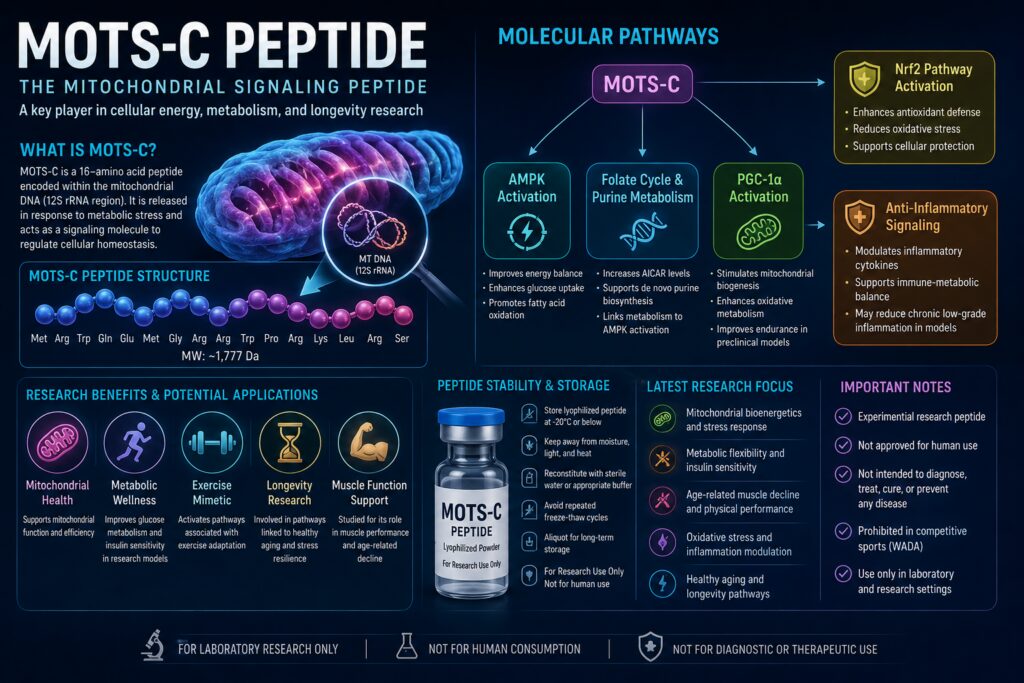
MOTS-C is a 16–amino-acid mitochondrial-derived peptide encoded by a short open reading frame within the 12S rRNA region of mitochondrial DNA. Its discovery helped expand scientific understanding of mitochondria beyond their traditional role as cellular “powerhouses.” Mitochondria are now understood as dynamic signaling organelles that communicate with the nucleus and other cellular systems through metabolites, reactive oxygen species, mitochondrial DNA fragments, and mitochondrial-derived peptides.
MOTS-C is especially interesting because it appears to function as a metabolic regulator. Research has associated MOTS-C with energy homeostasis, glucose metabolism, insulin sensitivity, exercise-like cellular signaling, stress adaptation, and age-related metabolic changes. This has led to growing interest in MOTS-C as a research subject in the fields of longevity science, metabolic health, mitochondrial biology, and cellular wellness.
The phrase “MOTS-C benefits” is widely searched online, but the most accurate wording is “potential MOTS-C research benefits” or “MOTS-C research applications.” Existing evidence is strongest in cell and animal models, with human research still limited. Therefore, MOTS-C should not be presented as an approved medical therapy or guaranteed wellness intervention.
2. Why MOTS-C Matters in Longevity and Wellness Research
Longevity research often focuses on the biological systems that decline with age. These include mitochondrial function, cellular energy production, metabolic flexibility, inflammation control, oxidative stress response, DNA repair, protein homeostasis, and cellular communication. MOTS-C is relevant because it appears to interact with several of these systems.
One of the most important themes in MOTS-C research is mitochondrial-to-nuclear communication. Cells must constantly adjust to changes in nutrient availability, exercise, oxidative stress, inflammation, and aging. MOTS-C appears to participate in this adaptive network by influencing metabolic pathways that help cells respond to stress and maintain energy balance.
In wellness-focused research, MOTS-C is often discussed in connection with:
- Mitochondrial health
- Metabolic flexibility
- Cellular energy balance
- Exercise-mimetic signaling
- Insulin sensitivity research
- Healthy aging pathways
- Oxidative stress response
- Inflammation modulation
- Muscle performance models
- Age-associated metabolic decline
These areas make MOTS-C a high-interest topic for educational content, SEO pages, research peptide catalogs, and longevity science blogs. However, all content should remain clear that MOTS-C is for research use only and is not approved to diagnose, treat, cure, or prevent disease.
3. Molecular Pathways of MOTS-C
3.1 AMPK Activation
One of the most important molecular pathways associated with MOTS-C is AMPK, or AMP-activated protein kinase. AMPK is often described as a cellular energy sensor. When energy availability is low or metabolic demand is high, AMPK helps shift cells toward energy-producing processes while reducing energy-consuming processes.
MOTS-C research suggests that the peptide may promote AMPK activation through metabolic changes involving the folate cycle and de novo purine biosynthesis. This can lead to accumulation of AICAR, a known AMPK-associated molecule. AMPK activation is relevant to studies involving glucose uptake, fatty acid oxidation, mitochondrial biogenesis, cellular stress response, and metabolic homeostasis.
Because AMPK is also activated by exercise, fasting, and nutrient stress, MOTS-C is sometimes described in the literature and popular wellness discussions as an “exercise-mimetic” peptide. This does not mean MOTS-C replaces exercise. Instead, it means researchers are studying whether MOTS-C activates some cellular pathways that overlap with exercise-induced metabolic signaling.
3.2 Folate Cycle and De Novo Purine Biosynthesis
MOTS-C has been reported to interact with the folate cycle and de novo purine biosynthesis. These pathways are deeply connected to nucleotide synthesis, methylation biology, cellular growth, metabolic regulation, and energy balance.
The folate-purine-AMPK pathway is one of the key mechanistic explanations for MOTS-C’s research interest. By influencing these pathways, MOTS-C may alter cellular energy sensing and adaptive stress signaling. This is one reason researchers study MOTS-C in models of metabolic stress, obesity, insulin resistance, and aging-related energy imbalance.
3.3 PGC-1α and Mitochondrial Biogenesis
PGC-1α is a major regulator of mitochondrial biogenesis and oxidative metabolism. Research has linked MOTS-C signaling with AMPK and PGC-1α-related pathways, making it relevant to studies on mitochondrial function, skeletal muscle metabolism, and energy efficiency.
In longevity research, mitochondrial biogenesis is a major area of interest because aging is often associated with reduced mitochondrial quality, impaired energy output, and increased oxidative stress. Compounds that influence AMPK and PGC-1α pathways are often studied for their potential role in supporting mitochondrial adaptation and cellular resilience.
3.4 Nrf2 and Oxidative Stress Response
Nrf2 is a transcription factor involved in antioxidant defense and cellular protection against oxidative stress. Some newer studies have explored MOTS-C in relation to Nrf2 signaling and mitochondrial protection.
Oxidative stress is a major theme in aging biology. Excessive oxidative damage can impair mitochondrial function, cellular membranes, proteins, and DNA. Research involving MOTS-C and Nrf2 is therefore relevant to longevity science, inflammatory models, and tissue stress-response studies.
3.5 Inflammation and Immune-Metabolic Signaling
MOTS-C has also been studied in connection with inflammatory signaling. Chronic low-grade inflammation is associated with aging, metabolic dysfunction, and reduced tissue resilience. Some preclinical studies suggest MOTS-C may influence inflammatory markers and improve cellular stress responses in experimental models.
This makes MOTS-C a relevant research topic for immune-metabolic studies, especially where inflammation and mitochondrial dysfunction overlap.
4. MOTS-C and Metabolic Research
Metabolic research is one of the strongest areas of interest for MOTS-C. Early studies explored its effects in models of obesity, insulin resistance, glucose handling, and diet-induced metabolic stress. These studies helped position MOTS-C as a mitochondrial peptide involved in metabolic homeostasis.
Important MOTS-C research topics include:
- Glucose metabolism
- Insulin sensitivity models
- Skeletal muscle glucose uptake
- Fatty acid oxidation
- Mitochondrial energy efficiency
- Metabolic flexibility
- Diet-induced obesity models
- Age-associated metabolic decline
Because metabolic dysfunction is closely related to aging, MOTS-C has become an important peptide in longevity-related research. Still, the phrase “MOTS-C benefits” should be handled carefully. The most defensible phrasing is that MOTS-C is being investigated for potential roles in metabolic signaling, mitochondrial function, and age-related cellular pathways.
5. MOTS-C and Exercise-Mimetic Research
Exercise is one of the most powerful known interventions for improving mitochondrial function, insulin sensitivity, muscle health, cardiovascular resilience, and healthy aging markers. MOTS-C has attracted attention because research suggests it may activate some cellular pathways that overlap with exercise adaptation.
MOTS-C has been studied in relation to skeletal muscle signaling, physical performance models, age-related physical decline, and mitochondrial efficiency. In some studies, MOTS-C levels appear responsive to exercise, supporting the idea that it may be part of the body’s natural adaptive response to physical stress.
For SEO purposes, phrases like “MOTS-C and exercise,” “MOTS-C exercise mimetic,” and “MOTS-C mitochondrial energy” are valuable. However, the content should avoid suggesting that MOTS-C is a replacement for exercise or an approved performance-enhancing product. It is more accurate to say that MOTS-C is being researched for its role in exercise-associated metabolic signaling.
6. MOTS-C and Longevity Research
MOTS-C is increasingly discussed in longevity research because mitochondrial function is central to aging biology. As organisms age, mitochondrial efficiency often declines. This can contribute to reduced energy production, increased oxidative stress, impaired cellular repair, and metabolic dysfunction.
MOTS-C research intersects with several longevity-related mechanisms:
- Mitochondrial stress response
- AMPK activation
- Metabolic flexibility
- Insulin sensitivity
- Inflammation regulation
- Oxidative stress defense
- Muscle function and age-related decline
- Cellular energy homeostasis
- Mitochondrial-nuclear communication
The strongest longevity-related claim is not that MOTS-C “extends lifespan” in humans, but that MOTS-C is being investigated in models relevant to healthy aging, mitochondrial function, metabolic adaptation, and age-associated decline.
7. Specific Research Use Cases for MOTS-C
7.1 Mitochondrial Function Studies
MOTS-C is highly relevant for studies involving mitochondrial function, mitochondrial stress response, oxidative phosphorylation, cellular respiration, and energy efficiency. Researchers may use MOTS-C in cell or animal models to evaluate mitochondrial adaptation under metabolic stress.
7.2 Metabolic Syndrome and Insulin Resistance Models
Because MOTS-C has been studied in relation to insulin sensitivity and glucose metabolism, it is often used in research models involving obesity, high-fat diet exposure, insulin resistance, and metabolic dysfunction.
7.3 Skeletal Muscle and Exercise Models
MOTS-C has research relevance in skeletal muscle studies because muscle is a major tissue for glucose disposal, energy expenditure, and exercise adaptation. Studies may explore MOTS-C in relation to endurance, mitochondrial bioenergetics, muscle aging, and exercise-associated signaling.
7.4 Inflammation and Oxidative Stress Models
MOTS-C may be studied in cellular models involving oxidative stress, inflammatory signaling, mitochondrial injury, and tissue protection. These models are especially relevant to aging research because chronic inflammation and oxidative stress are common features of age-associated decline.
7.5 Longevity and Healthy Aging Models
MOTS-C is increasingly positioned as a longevity research peptide because of its relationship with mitochondrial communication, cellular stress response, and metabolic regulation. Researchers may investigate MOTS-C in models of age-associated metabolic decline, muscle function, or tissue resilience.
8. Peptide Stability and Storage Considerations
Peptide stability is a major SEO topic for MOTS-C because researchers often search for information on storage, reconstitution, shelf life, and handling. Like many research peptides, MOTS-C stability can be affected by temperature, moisture, light exposure, repeated freeze-thaw cycles, pH, solvent choice, and contamination risk.
In general research handling discussions, lyophilized peptides are commonly stored cold, dry, protected from light, and sealed to minimize moisture exposure. Once reconstituted, peptides are usually more vulnerable to degradation and contamination, so laboratory best practices often include sterile technique, refrigeration when appropriate, aliquoting to reduce repeated freeze-thaw cycles, and using validated storage protocols.
Key peptide stability considerations include:
- Keep lyophilized peptide dry and protected from moisture.
- Minimize exposure to room temperature when possible.
- Avoid repeated freeze-thaw cycles after reconstitution.
- Use sterile research-grade handling procedures.
- Protect from direct light when stability is a concern.
- Use aliquots for repeated experimental access.
- Follow supplier COA, SDS, and handling documentation.
- Do not assume stability without analytical verification.
For SEO content, useful phrases include “MOTS-C peptide stability,” “MOTS-C storage,” “MOTS-C reconstitution research,” “lyophilized MOTS-C,” and “MOTS-C handling protocol.” However, content should avoid giving consumer injection instructions or implying personal use.
9. Latest Research Trends
Recent research trends around MOTS-C include mitochondrial bioenergetics, age-related metabolic decline, muscle function, pancreatic islet aging, oxidative stress defense, and cellular resilience. Researchers are also paying closer attention to mitochondrial-derived peptides as a broader category, including MOTS-C, humanin, and SHLPs.
Major trends include:
9.1 Mitochondrial-Derived Peptides as Signaling Molecules
MOTS-C is part of a growing field focused on mitochondrial-derived peptides. These peptides challenge the older view that mitochondria are only energy-producing organelles. Instead, mitochondria are now understood as communication hubs that help regulate metabolism, stress response, inflammation, and aging biology.
9.2 Metabolic Flexibility and Healthy Aging
MOTS-C is being studied in relation to the body’s ability to switch between fuel sources, respond to nutrient stress, and maintain glucose and lipid balance. This makes it relevant to metabolic flexibility research and longevity-focused science.
9.3 Muscle Aging and Physical Performance Models
Research interest continues around MOTS-C and skeletal muscle function, especially in age-associated physical decline and mitochondrial efficiency. This area is especially relevant because muscle health is a major predictor of metabolic health and functional longevity.
9.4 Nrf2, Oxidative Stress, and Tissue Protection
Newer studies are exploring MOTS-C in connection with antioxidant defense systems such as Nrf2. This may help explain how MOTS-C participates in cellular stress-response pathways.
9.5 Translational Gaps and Human Evidence
Although MOTS-C has strong preclinical research interest, human evidence remains limited. This is one of the most important points for responsible content. MOTS-C should be described as promising but investigational, with more clinical research needed to determine safety, efficacy, pharmacokinetics, dosing, and long-term outcomes.
10. Regulatory Insights and Compliance Considerations
MOTS-C is an experimental peptide and is not approved by the FDA as a treatment for any disease or medical condition. It should not be marketed with claims that it diagnoses, treats, cures, prevents, or mitigates disease. Research-use-only products should be presented strictly for laboratory research, analytical work, or preclinical investigation.
Regulatory agencies have increased scrutiny of peptide sellers, especially when products are labeled “Research Use Only” but marketed with human-use claims. This means businesses should be careful with wording. Even if a product is labeled RUO, claims about weight loss, anti-aging, disease treatment, dosing, injections, or personal wellness outcomes may create regulatory risk.
Safer compliance language includes:
- “For research use only.”
- “Not for human consumption.”
- “Not intended to diagnose, treat, cure, or prevent disease.”
- “For laboratory and preclinical research applications.”
- “Investigational compound.”
- “Research interest includes mitochondrial signaling and metabolic pathways.”
- “Human safety and efficacy have not been established.”
Avoid language such as:
- “MOTS-C burns fat.”
- “MOTS-C treats diabetes.”
- “MOTS-C reverses aging.”
- “MOTS-C is safe for human use.”
- “MOTS-C improves your energy.”
- “MOTS-C dosage for weight loss.”
- “Inject MOTS-C for longevity.”
MOTS-C is also prohibited in sport under anti-doping rules because of its relationship to AMPK activation and metabolic modulation. Athletes and competitive individuals should be aware that MOTS-C may create anti-doping risk.
11. SEO Strategy for MOTS-C Content
A strong MOTS-C SEO page should balance scientific depth, search intent, and compliance. The goal is to rank for valuable search terms while avoiding unsupported or risky claims.
Primary Keyword
MOTS-C benefits
Recommended SEO Title Options
- MOTS-C Benefits: Mitochondrial Peptide Research, Stability & Longevity Pathways
- MOTS-C Peptide Research: Molecular Pathways, Stability and Wellness Trends
- MOTS-C and Mitochondrial Health: Research Uses, AMPK Pathways and Longevity Science
- MOTS-C Peptide Stability and Research Applications in Metabolic Wellness
- MOTS-C Benefits in Research: Longevity, Metabolism and Mitochondrial Pathways
Recommended H1
MOTS-C Peptide Research: Stability, Molecular Pathways, and Longevity-Focused Wellness Science
Recommended H2 Headings
- What Is MOTS-C?
- MOTS-C Benefits in Research
- How MOTS-C Supports Mitochondrial Pathway Studies
- MOTS-C and AMPK Activation
- MOTS-C Peptide Stability and Storage
- MOTS-C and Longevity Research
- MOTS-C and Metabolic Wellness Trends
- Is MOTS-C Approved for Human Use?
- Research Use Only Disclaimer
Suggested Internal Link Anchors
- Research peptides
- Mitochondrial peptides
- Peptide stability
- Longevity research
- Metabolic wellness research
- AMPK pathway research
- RUO peptide products
- Certificates of Analysis
Suggested FAQ Schema Questions
What is MOTS-C?
MOTS-C is a mitochondrial-derived peptide encoded by mitochondrial DNA. It is studied for its role in cellular energy regulation, metabolic signaling, mitochondrial stress response, and aging-related pathways.
What are MOTS-C benefits in research?
MOTS-C research focuses on mitochondrial function, AMPK activation, metabolic flexibility, insulin sensitivity models, oxidative stress response, inflammation, and healthy aging pathways. Human clinical benefits have not been established.
Is MOTS-C approved for human use?
No. MOTS-C is an experimental research peptide and is not FDA-approved to diagnose, treat, cure, or prevent any disease.
How stable is MOTS-C?
MOTS-C stability depends on storage conditions, temperature, moisture, light exposure, reconstitution method, and handling practices. Lyophilized peptides are typically handled under cold, dry, research-grade conditions, and reconstituted peptides require stricter handling to reduce degradation and contamination risk.
Why is MOTS-C studied in longevity research?
MOTS-C is studied in longevity research because it interacts with pathways related to mitochondrial function, AMPK signaling, oxidative stress response, inflammation, metabolic homeostasis, and age-associated decline.
12. BOSS Peptides Website Description Version
MOTS-C is a mitochondrial-derived research peptide studied for its role in cellular energy regulation, metabolic signaling, and mitochondrial stress-response pathways. As interest in longevity science continues to grow, MOTS-C has become a key focus in research involving AMPK activation, metabolic flexibility, oxidative stress response, inflammation, and age-associated cellular function.
At BOSS Peptides, MOTS-C is offered strictly for research use only. It is not intended for human consumption, medical use, or the diagnosis, treatment, cure, or prevention of any disease. Researchers interested in mitochondrial peptides, metabolic pathway analysis, and longevity-focused cellular studies often evaluate MOTS-C for its connection to mitochondrial communication and energy homeostasis.
13. Conclusion
MOTS-C is one of the most compelling mitochondrial-derived peptides in modern metabolic and longevity research. Its connection to AMPK activation, folate-purine metabolism, mitochondrial bioenergetics, oxidative stress response, inflammation, and age-related metabolic decline makes it a valuable subject for scientific investigation.
For SEO purposes, MOTS-C content can be highly impactful when built around topics such as “MOTS-C benefits,” “MOTS-C peptide stability,” “MOTS-C molecular pathways,” “MOTS-C and longevity,” and “MOTS-C mitochondrial health.” However, responsible content must clearly separate research findings from human-use claims. MOTS-C remains investigational, and human safety, efficacy, dosing, and long-term outcomes have not been fully established.
The best approach is to position MOTS-C as a research-use-only peptide with strong scientific relevance in mitochondrial biology, metabolic signaling, and longevity-focused cellular research.